

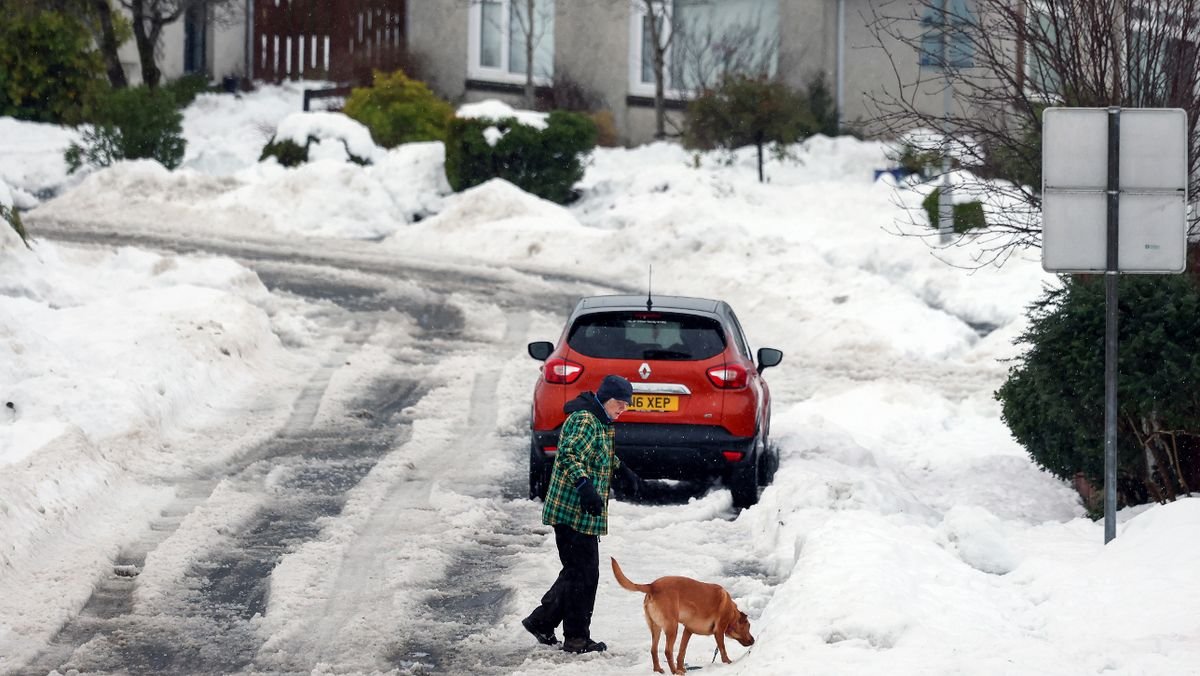

Britons are being cautioned about an impending clash in weather patterns over the United Kingdom, as meteorologists anticipate a battle between mild Atlantic air and frigid air moving in from the east, heightening the chances of snowfall and a significant drop in temperatures towards the end of the month.
The UK’s Met Office has indicated an increased likelihood of colder conditions making a comeback later in January following the impact of Storm Goretti, which recently struck the nation with snow, heavy rainfall, and near-hurricane-force winds. Meteorologist Greg Dewhurst highlighted that the upcoming days could signify a pivotal moment, with a potential clash between mild weather and the possibility of colder conditions.
Storm Goretti, characterized as a “multi-hazard event,” brought wind gusts approaching 100mph and prompted a rare red weather warning for severe, stormy winds in southwestern England. Tragically, a man in his 50s lost his life in Helston, Cornwall, when a tree fell on his caravan due to the storm’s fierce impact. Flights were canceled, trains faced disruptions, and numerous schools had to shut down. Forecasters are now closely monitoring to see which weather system will prevail.
The Met Office stated that the UK is poised for a showdown between Atlantic weather systems pushing in from the west and high pressure with colder conditions trying to influence from the east. Initially, milder Atlantic air is anticipated to dominate, ushering in cloudy and unsettled weather with showers and temperatures around average levels.
However, forecasters caution that the situation could change. They mentioned, “This part of the forecast remains somewhat uncertain, but the potential shift to colder weather also raises the likelihood of snowfall in various parts of the country.”
According to WXCharts weather maps, the timing of a potential ‘Beast from the East’ is pinpointed, with Arctic air possibly advancing westward from around the middle of next week. The data suggests snowfall could commence in the early hours of January 27, first hitting Wales, Scotland, and Northern Ireland before spreading rapidly south and eastward.
Snowfall intensity may increase during the day, with rates of up to 0.4 inches per hour, spanning from Colchester in Essex to just below Inverness by early evening. Predictions indicate that snow might reoccur on January 29, blanketing the UK entirely, covering over 600 miles, with accumulations of up to two inches in numerous areas.
By the early hours of January 30, only London, parts of the east coast, the far west of Devon, and limited regions of south Wales may avoid snowfall. Simultaneously, temperatures could plummet, with expected overnight lows of -1C to -6C across England, around -5C in Wales, and dropping as low as -12C in certain parts of Scotland, particularly near Inverness, where snow could persist.
Nevertheless, Met Office spokesperson Grahame advised caution, emphasizing that the deep freeze is not guaranteed. He emphasized, “Colder weather is not anticipated for the UK in the immediate future. Temperatures through most of next week are expected to remain close to the average range.”
He further added, “While there is a slight chance that easterly winds could bring colder conditions towards the end of January, it is still a considerable time away, allowing room for forecast adjustments. Presently, there is an equal likelihood of persisting mild air from the south, keeping the cold at bay.”