

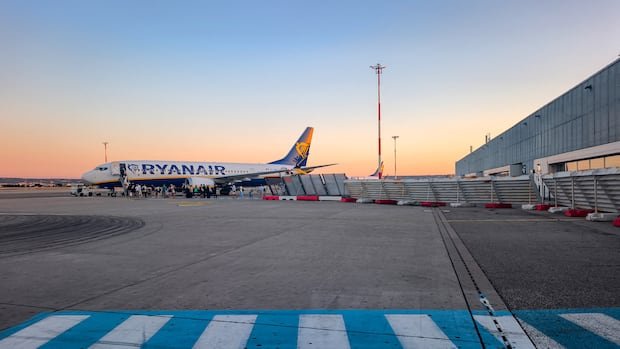

A Ryanair aircraft experienced an alarming incident last month when a broken engine part caused a window to shatter shortly after takeoff in Greece. The malfunction resulted in a man’s head being drawn towards the opening before other passengers managed to pull him back inside, according to findings released by U.S. investigators on Thursday.
The incident occurred on July 10 as the Boeing 737-800 departed Thessaloniki, Greece. Investigations revealed that a fan blade in the right engine dislodged, leading to fragments damaging the window and several parts of the fuselage. The U.S. National Transportation Safety Board (NTSB) took over the inquiry under international aviation protocols.
Initial reports suggest that bird remains were discovered inside the engine, indicating a possible bird strike during takeoff. However, the exact cause of the fan blade detachment remains undetermined. The 61-year-old passenger involved suffered neck and shoulder injuries along with friction burns.
Flight attendants reported hearing loud vibrations and observing smoke or fog in the cabin following the engine issue. Passengers raised alarm when they saw the man trapped in the damaged window and promptly pulled him back inside. Medical aid was provided to the injured passenger, who was relocated to another seat for treatment. Passengers also assisted by using a metal box to cover the damaged window until the plane could land safely.
Maintenance records revealed that the failed fan blades underwent ultrasonic inspections in May 2026 and November 2025, showing no prior damage. However, flight crews had reported four suspected bird strikes on the same engine in the past year, with bird remains found after two incidents.
Ryanair CEO Michael O’Leary was reprimanded by the NTSB for prematurely discussing the investigation’s focus on foreign object damage. The agency emphasized that all possibilities were still under review and unauthorized disclosures were inappropriate.
The FAA had issued directives in 2025 to reinforce engine coverings on Boeing 737s following previous incidents of fan blade failures. These directives aimed to prevent engine covering fragments from detaching in case of a fan blade malfunction. The NTSB report highlighted that the required modifications had not been completed on the Ryanair aircraft involved in the recent incident.
Experts suggest that the FAA and NTSB might reconsider the deadline for the modifications in light of the recent event. The FAA reaffirmed its commitment to supporting the NTSB in the ongoing investigation and pledged to take necessary safety measures based on the findings.
The aircraft, a 737-800 with a capacity of up to 189 passengers, was delivered to Ryanair in 2008. Flight data indicated a significant altitude change shortly after takeoff, with the aircraft descending to burn fuel before returning to Thessaloniki. The flight was operated by Malta Air, a subsidiary of Ryanair, and concluded with a normal landing, allowing passengers to disembark safely.