

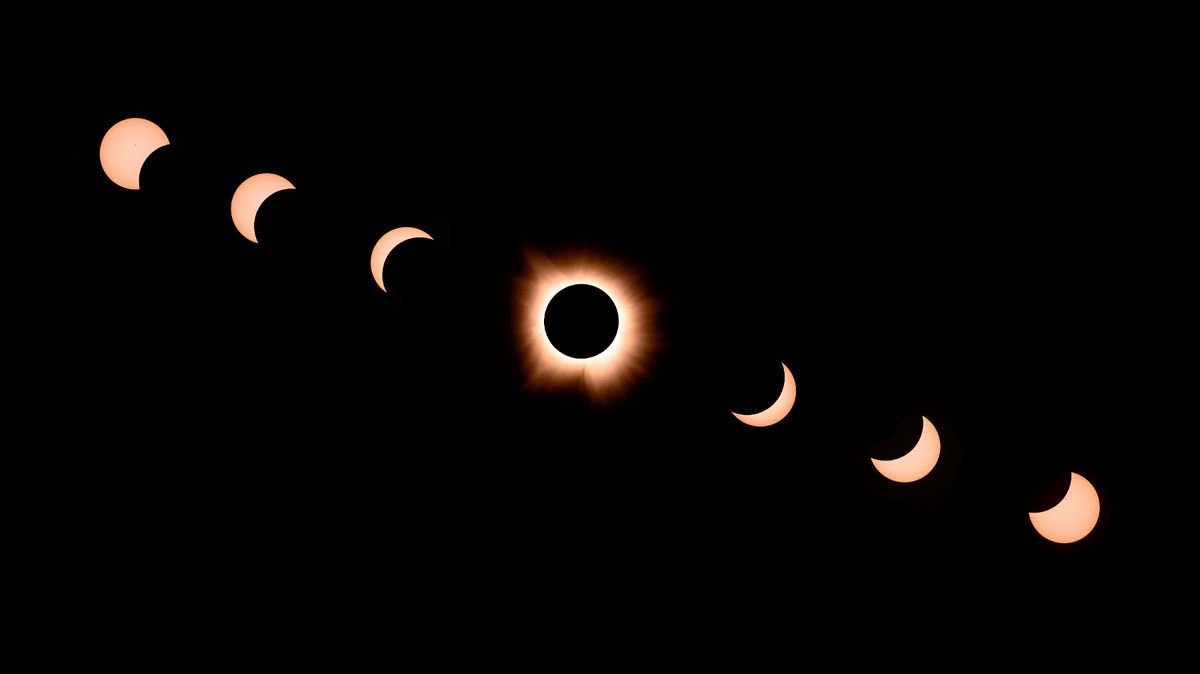

A spectacular solar eclipse, dubbed the ‘eclipse of the century,’ is set to grace the skies this year. However, the viewing of this rare event in its entirety will be limited to only a few locations across the globe.
Eclipses have captivated civilizations for ages, with these celestial occurrences, where the Moon blocks the sun, influencing various aspects of human culture, from music and art to literature and historical events. In the sixth century, a total solar eclipse played a pivotal role in bringing an end to a longstanding conflict between the Lydian and Medes kingdoms in what is now modern-day Turkey, as both sides interpreted the event as a divine call for peace.
The most recent total solar eclipse visible in the UK took place on August 11, 1999, drawing millions of spectators who witnessed the sky darken as the Moon cast its shadow. The next opportunity to witness a total solar eclipse in the UK will not occur until 2090. However, enthusiasts can travel to select regions to observe the upcoming total solar eclipse on August 12, 2026, in all its splendor.
This rare celestial event will be visible along a narrow path extending from Iceland’s east coast through Spain and down to the Balearic Islands. In Reykjavík, Iceland, the eclipse will peak at 5.48pm local time, lasting just over a minute, while in Gijón, Spain, it will occur at 8.28pm local time, with a duration of one minute and 45 seconds.
The phenomenon of totality will be experienced in Burgos, Spain, at 8.28pm, diminishing to around one minute and 25 seconds in Zaragoza at 8.29pm, and lasting approximately a minute and a half in Mallorca at 8.31pm. Meanwhile, the UK will witness a partial lunar eclipse on the same day, resulting in a dimmed sky effect akin to a heavily overcast day or twilight, with between 89% and 91% of the sun’s surface obscured by the Moon across most of the country.
As the eclipse reaches its peak at 7.13pm BST, a striking crescent shape will adorn the sky. Though not a total solar eclipse, areas like the Isles of Scilly off Cornwall will experience 96% coverage, leading to a significantly darker sky.
For those eager to witness a total eclipse, mark your calendars for August 2, 2027, which will host one of the longest-duration total eclipses in a century. Best viewed from North Africa, including Egypt, Morocco, and Tunisia, Gibraltar, a British territory, will also be within the path of totality. In the UK, around 42% of the sun will be obscured by the Moon, offering a more modest spectacle compared to the total eclipse in other regions.