

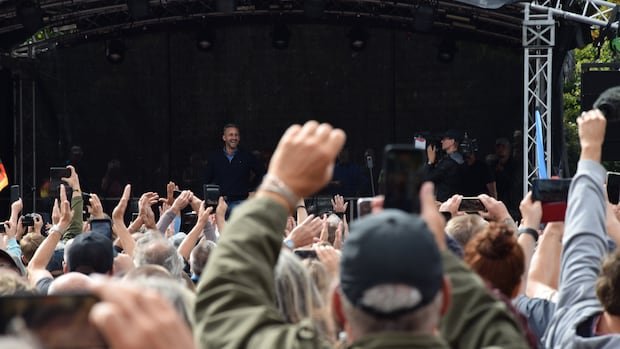

Germany’s far-right movement is gaining traction in certain regions of the country, where researchers have observed an increasing openness among supporters to express their views publicly, sometimes through subtle means without overt political symbols.
During recent gatherings of the Alternative for Germany (AfD) party, coded messages were detected on seemingly ordinary items like sneakers and T-shirts. This covert messaging often involves brands such as New Balance and Lonsdale, which are being utilized as veiled references to nationalist and Nazi ideologies, a significant development in Germany due to strict laws prohibiting the display of Nazi symbols.
According to Gideon Botsch, head of the Emil Julius Gumbel Research Unit on Antisemitism and Right-Wing Extremism at Potsdam University, various signs associated with the extreme right have become more prevalent at these events. Some symbols are overtly right-wing and neo-Nazi, while others are more ambiguous or subtle in their messaging.
For instance, New Balance has been appropriated by some individuals to interpret the “N” on its sneakers as representing “nationalist,” and “NB” as short for “Nationale Bewegung,” or “national movement.” Similarly, Lonsdale has witnessed a resurgence in popularity among the far right, as its logo can be manipulated to spell out NSDA, an abbreviation associated with Germany’s National Socialist Party.
The use of such coded symbols allows individuals to convey their affiliations discreetly, exploiting legal loopholes that prohibit explicit Nazi imagery. This tactic has become increasingly prevalent, as highlighted by the Saxony-Anhalt intelligence service updating its guide on far-right symbols to focus on covert messaging rather than prosecutable symbols.
The rise of the AfD, once a fringe party in 2013, now positioned as the probable winner of an upcoming state election in Saxony-Anhalt, marks a significant shift in Germany’s political landscape. If successful, this would mark the first time since World War II that a far-right party secures an absolute majority in a German state.
Fabian Wichmann, an expert at the EU Knowledge Hub on Preventing Radicalization, notes a growing overlap between Germany’s neo-Nazi movement and the broader populist right, with neo-Nazi groups actively endorsing the AfD and mobilizing their supporters to vote for the party.
While not everyone sporting brands like New Balance or Lonsdale is a neo-Nazi, the presence of such symbols has become emblematic of shared narratives and ideologies within far-right circles. Researchers emphasize that the significance lies not just in the clothing itself but in the growing audacity of individuals to display these signals openly, reflecting the increasing influence of Germany’s far right and the AfD.
Both New Balance and Lonsdale have distanced themselves from far-right associations, with Lonsdale specifically combating its appropriation by implementing anti-racism initiatives to counter its association with extremist groups. Nevertheless, the resurgence of such brands among far-right extremists underscores the ongoing challenge of preventing their misuse.
In contrast, brands like Thor Steinar, recognized for its Nordic and runic imagery, are considered clearer indicators of far-right affiliations due to their longstanding association with Germany’s extremist scene. Despite legal disputes over its original logo resembling banned SS symbols, Thor Steinar has managed to navigate legal challenges by introducing alternative branding to avoid punitive measures.