

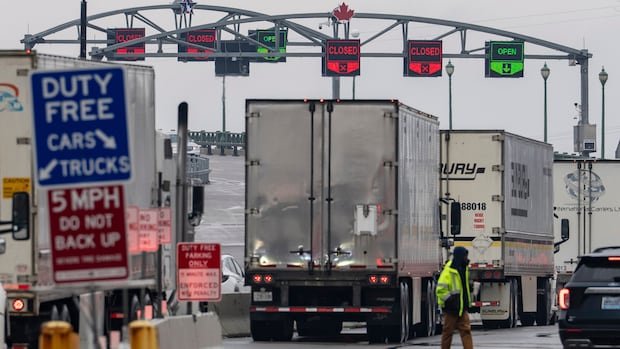

Enforcement of cross-border cargo regulations has significantly intensified during the current administration, causing delays and financial burdens for shippers. According to industry insiders, there has been a notable increase in freight screenings and penalties, reflecting a more protectionist stance by the United States on customs matters.
Breanna Leininger, who oversees operations in the U.S. for Pacific Customs Brokers in Vancouver, described the shift as substantial. She noted a tenfold rise in border officials’ requests for documentation on shipped goods compared to previous years. The scrutiny by customs authorities has become more stringent, with a significant rise in the frequency of in-depth examinations.
To ensure compliance with product classifications and trade agreements, importers are now required to furnish extensive paperwork such as labor and manufacturing records. The level of proof and the specific items subject to tariffs appear to be evolving regularly, creating challenges for businesses like Pacific Customs Brokers.
Recent statistics support reports of heightened enforcement measures. U.S. Customs and Border Protection data reveals a projected 26% increase in audits this year compared to 2024. These audits assess importers’ adherence to tariff classifications, customs valuations, and free-trade agreements like the Canada-United States-Mexico Agreement.
In the first half of the current year, U.S. customs authorities collected $70.6 million US in trade penalties, marking a significant surge from previous years. This trend highlights the increasing financial impact on businesses engaging in cross-border trade.
The intensified enforcement efforts coincide with a growing trade dispute between Canada and the U.S., leading to additional tariffs imposed by both countries. The resulting border delays and heightened documentation requirements have escalated costs and logistical challenges for shippers, potentially discouraging cross-border trade.
Alan Dewar, an executive vice president at GHY, a customs brokerage in Winnipeg, emphasized the substantial financial implications of the increased enforcement measures. He highlighted the additional costs incurred due to delays, spoilage, and service charges, further straining businesses operating across the U.S.-Canada border.
Despite the challenges posed by the evolving customs landscape, some businesses have managed to navigate the changes. However, others have found the regulatory environment too complex, leading to potential disruptions in cross-border trade. U.S. Customs and Border Protection emphasized the importance of importers providing accurate information and complying with regulatory requirements to facilitate smooth trade operations.