

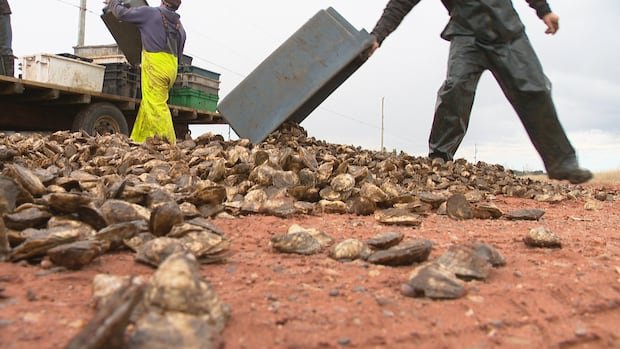


While tending to their oyster farm in western P.E.I., Kaila Richard often reflects on her late father, who managed the farm until his sudden passing due to an accident in 2021.
Kaila, now overseeing the Dock River farm near Alberton with her husband Bruce Richard, feels her father’s presence profoundly during their daily operations.
She shared, “When we make mistakes, I can almost hear my dad saying, ‘What are you doing?!’ … and when things go well, I envision how proud he would be,” in an interview with CBC Radio’s The Current.
The Richard family heavily invested in upgrading the farm through significant loans in recent years, introducing new costly equipment and dedicating long hours to nurture their oyster harvest. However, their hard work faces a threat from two diseases devastating the oyster industry in Prince Edward Island.
A substantial number of dead oysters have been retrieved by farmers, with shells accumulating across P.E.I.
Bruce described the situation, stating, “The entire island is currently in a dire state. In our river section alone, around a dozen farmers are collectively experiencing severe losses, with mortality rates reaching up to 90 to 95 percent.”
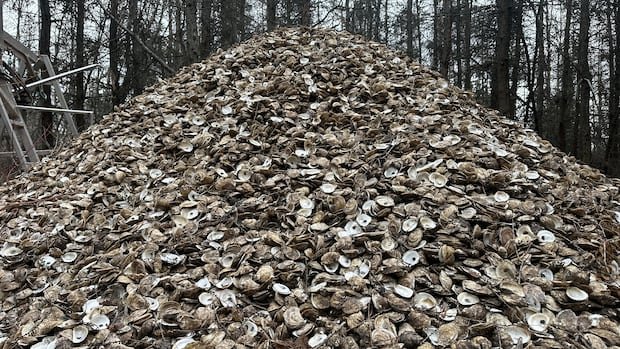
Numerous oyster farmers in western P.E.I. are witnessing complete mortality in their enclosures as they retrieve them after the winter season. The region has been severely affected by two oyster diseases, MSX and dermo, in recent times. CBC’s Nancy Russell reports on this issue.
The diseases, multinucleate sphere unknown (MSX) and dermo, were identified in P.E.I. waters in 2024 and 2025, respectively. Although harmless to humans, these parasites are fatal to oysters, leading to some farmers reporting a 100 percent mortality rate.
The provincial and federal governments unveiled various support initiatives earlier this year, including financial aid, mental