

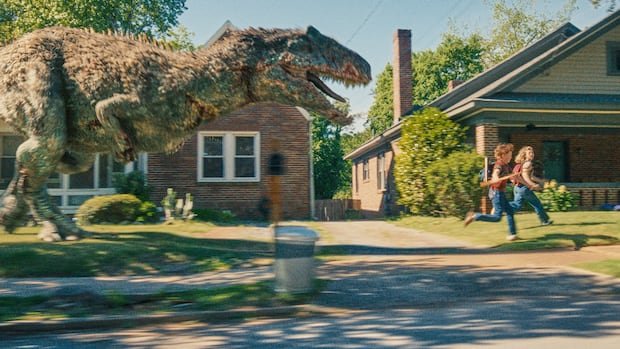

A massive serpent-like creature emerges from a neighboring pool while feathered lizards pursue a family along their driveway. In the film “The End of Oak Street,” these surreal scenes unfold in a cinematic blend of dinosaur lore and nostalgia for “Jurassic Park.” Despite Hollywood’s long-standing fascination with prehistoric creatures, the movie offers a fresh take on dinosaurs, incorporating insights from paleontologists. CBC News consulted experts to discuss the film’s accurate portrayal of feathers and fauna, as well as where creative liberties were taken to fill gaps in the fossil record that continue to perplex researchers.
One of the intriguing questions raised by the film is the depiction of dinosaur mating behavior, sparking curiosity among viewers. Paleontologist Victoria Arbour from the Royal B.C. Museum praised the film’s inclusion of feathers on dinosaurs, a departure from earlier Hollywood renditions that often omitted this feature. The link between dinosaurs and birds has been a subject of scientific interest dating back to the early days of evolutionary theory. Recent fossil discoveries, notably the first feathered non-avian dinosaur, Sinosauropteryx prima in China, have revolutionized our understanding of dinosaurs as feathered creatures.
The film challenges traditional portrayals of dinosaurs by showcasing a diverse range of species, some of which are based on scientific plausibility while others delve into imaginative realms. The Allosaurus in the movie, adorned with feathers, reflects a credible evolutionary connection to birds, as noted by researcher Caelan Libke from Carleton University. However, some creatures depicted in the film, such as the aquatic giant resembling Titanoboa and the peculiar furry sauropods, veer into creative fantasy rather than scientific accuracy.
Notably, the film’s portrayal of sauropods engaging in mating behavior raises eyebrows among scientists due to the inherent challenges in reconstructing such interactions from fossil evidence. The elusive nature of dinosaur reproduction, compounded by the scarcity of preserved soft tissues, leaves much room for speculation. While the movie takes artistic liberties in depicting dinosaur courtship, the scientific community remains intrigued by the mysteries surrounding dinosaur mating rituals.
In conclusion, “The End of Oak Street” offers a whimsical yet thought-provoking exploration of dinosaur behavior, blending scientific insights with imaginative storytelling. While certain aspects may stretch the boundaries of scientific plausibility, the film succeeds in sparking conversations about the enigmatic lives of dinosaurs and the evolving interpretations of their prehistoric world.