

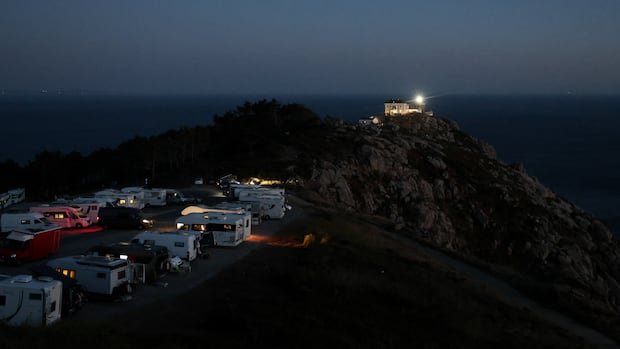

Hundreds of thousands of visitors have flocked to Spain to witness the solar eclipse happening on Wednesday. However, the event coincides with high temperatures and an increased risk of wildfires in the country, sparking concerns for officials aiming to prevent any fire damage caused by the surge in astrotourism.
Virginia Barcones, the secretary general for civil protection and emergencies at Spain’s Interior Ministry, emphasized the need to curb activities that could potentially trigger wildfires due to the challenging wildfire season Spain has been facing. This summer has been particularly harsh, with numerous forest fires scorching the land. A staggering 603,000 acres (2,440 square kilometers) have already been consumed by around 400 fires this year, as reported by the European Forest Fire Information System.
To mitigate the risk of additional fires during the eclipse, authorities are deploying 35,000 officers to monitor large outdoor gatherings, aiming to swiftly detect and extinguish any potential fires. Spain is a prime spot for observing the solar eclipse, with a narrow band of totality passing through various countries, including northern Russia, eastern Greenland, western Iceland, northeastern Portugal, and a substantial portion of northern Spain, concluding at the Balearic Islands.
Only individuals within the path of totality will witness the complete coverage of the sun by the moon. While Canada will experience a partial eclipse, viewers are reminded to use proper eye protection such as eclipse glasses. This rare solar event marks the first time mainland Spain will witness a full solar eclipse in over a century, attracting a surge in travel interest.
Special measures have been implemented by the Ministry of the Interior to manage the large crowds expected for the eclipse. Searches for accommodation along the eclipse’s path have surged, with Valencia experiencing a notable 245% spike in searches compared to the previous year, as reported by Expedia Group.
Authorities have designated 660 official viewing sites to accommodate the anticipated influx of over 440,000 spectators, with an estimated 1.5 million people expected to be on the move towards these locations. Both national and local authorities are cautioning tourists against activities like barbecuing and venturing into dry areas prone to wildfires.
The economic impact study conducted by the Ministry of Economy, Trade, and Business projects that the eclipse will contribute over 347 million euros to Spain’s economy. However, ongoing dry conditions and the looming threat of wildfires persist in the country. AEMET, Spain’s meteorological agency, forecasts very high to extreme forest fire risks across the Iberian Peninsula and the Balearic Islands on the day of the eclipse.
With temperatures expected to soar, reaching up to 35°C and even 40°C in certain regions, the risk of wildfires remains high. Despite these challenges, the enthusiasm for the eclipse among travelers remains strong. Professor Jan Cami from Western University in London, Ont., notes that witnessing this celestial event can be a transformative experience, prompting many to plan future trips to witness more eclipses.
As the eclipse fervor continues to build, Cami hopes that tourists in Spain will not only marvel at the eclipse but also reflect on the broader implications of climate change and the country’s struggles. This year’s eclipse is just the beginning of a series, with two more solar eclipses expected in the coming years, promising more opportunities for astrotourism and celestial spectacle.