

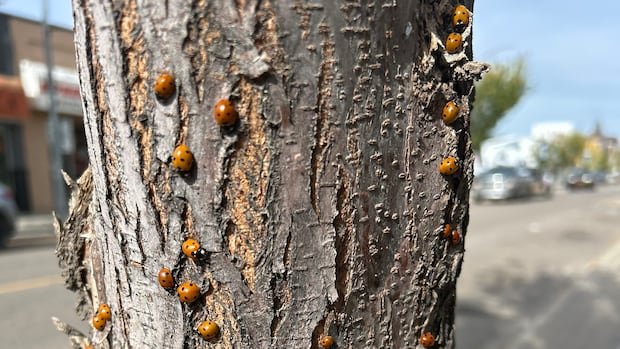

Ladybugs are highly prevalent throughout Saskatchewan this month as they prepare for hibernation, as per expert opinions. Georgiana Antochi-Crihan, the entomologist for the City of Saskatoon, mentioned to Candice Lipski of Saskatoon Morning that ladybugs experience cycles of population increases and declines, with the current period being a surge in ladybug numbers. She emphasized that the availability of food plays a key role in this phenomenon.
Ladybugs primarily feed on aphids, scale insects, mealybugs, and other pests. Although Ashley Thompson, the manager of parks technical services in Regina, noted a significant abundance of aphids in the city this year, she did not observe a major surge in ladybug populations. Similarly, Vesna Fa in North Battleford observed a high number of aphids during the summer, attracting ladybugs to the area.
Fa, the executive director of Midwest Food Resources, a food security non-profit, highlighted the importance of preserving ladybugs as beneficial insects in gardens. Candace Savage, chair of Wild About Saskatoon, commended the province’s diverse ladybug population for their environmental contributions, noting the existence of approximately 75 ladybug species in Saskatchewan, both native and introduced.
Thompson explained that the visible increase in ladybug activity in Regina during this period is related to their impending hibernation. Antochi-Crihan elaborated on the survival mechanisms of ladybugs during the harsh prairie winters, mentioning their ability to produce antifreeze-like compounds to withstand freezing temperatures. The experts anticipate another surge in ladybug numbers come spring as they emerge from hibernation.