

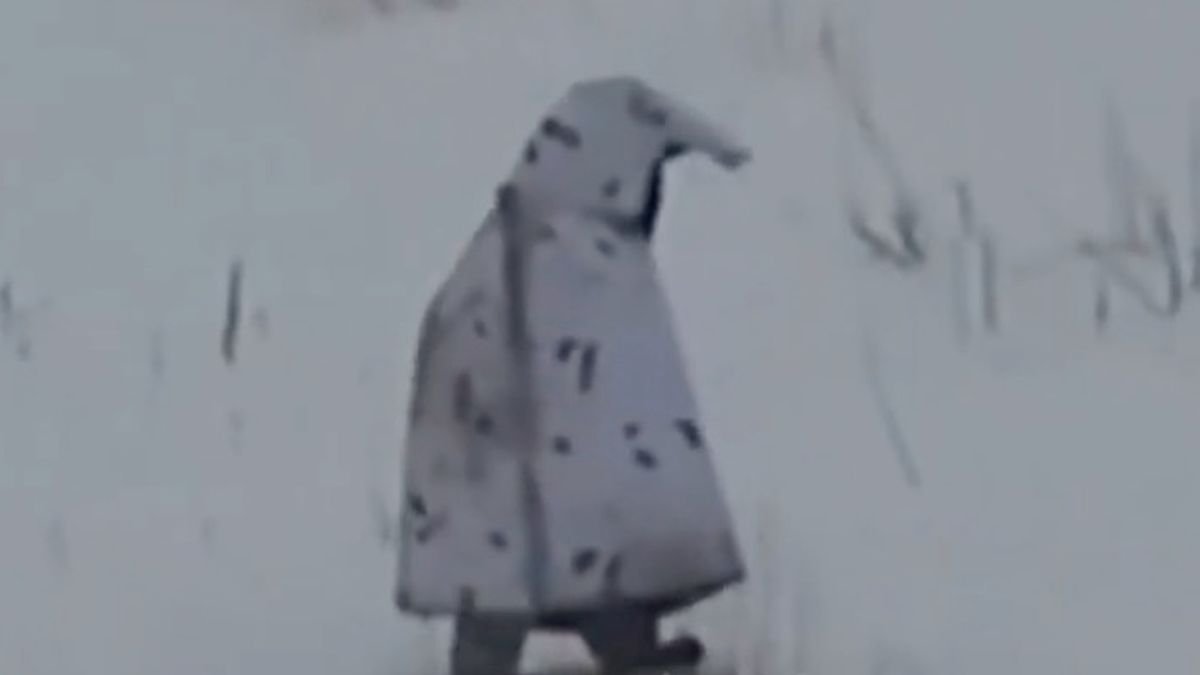

In a peculiar incident on the Ukrainian battlefield, a Russian soldier met his demise in an airstrike while donning a penguin-like disguise. The soldier was observed wandering in a snowy landscape, wearing a peculiar hooded outfit with squared shoulders and a protruding “beak.”
The camouflage outfit, seemingly intended to evade drone detection, failed to shield the soldier from Ukrainian forces, as evidenced in footage showing the soldier being targeted and swiftly eliminated. Despite the thermal blocking cape leaving the soldier’s feet exposed, it provided no defense against Ukrainian ordnance.
Russian troops have been utilizing thermal cloaks to evade Ukrainian drones, but their effectiveness has been hindered by technical flaws and insufficient training in proper use. These suits inadvertently make soldiers more visible against thermal imaging, making them easy targets for Ukrainian munitions.
Former British Army colonel, Hamish de Bretton-Gordon, emphasized that these cloaks do not provide invisibility and actually make soldiers more detectable due to contrasting temperature profiles. Drones have accounted for the majority of casualties in the conflict, as highlighted in a recent intelligence report by a Latvian agency.
The report underscores the impact of drones on the conflict, attributing 70-80% of injuries and deaths to these devices. The agency warns that while drones enhance tactical dynamics, they diminish the likelihood of a strategic breakthrough by either side. Additionally, concerns have been raised about Russia’s potential establishment of a drone production facility in Belarus, with the capacity to supply a significant number annually.