

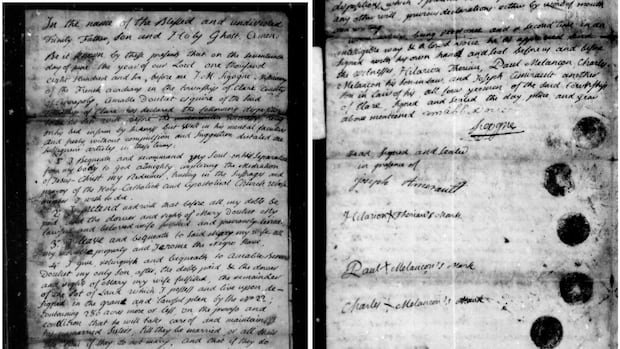

Hilarion Thériault, a 71-year-old Acadian, made a will as he sensed his end was near, a rare practice among Acadians in the 19th century due to their limited property ownership post-deportation. Thériault’s will, aimed at ensuring preparedness, highlighted the challenges faced by Acadians in securing property rights.
Colby Gaudet, a post-doctoral researcher at Dalhousie University, delved into Thériault’s will and 23 others from Clare, N.S., to explore how families managed legal and religious customs during times of grief. Gaudet emphasized the dual nature of resistance and adherence displayed by Acadians in upholding their Roman Catholic identity while navigating the existing legal framework.
Thériault’s will stressed the importance of settling debts, seeking reparations for any injustices, and fostering peace within the family. Maurice Basque, a historian at l’Institut d’études acadiennes at the Université de Moncton, contextualized these wills within the backdrop of societal discrimination against Acadians post-deportation in the 18th century.
The forced expulsion of Acadians in 1755 led to the loss of their lands, which were subsequently claimed by the Crown and redistributed to settlers from New England. Basque highlighted the British agenda to diminish the Acadian population by preventing their return and limiting their access to positions of power through religious tests.
Gaudet noted the language barrier faced by Acadians when dealing with Anglo-Protestant county judges who oversaw wills, with all wills examined being drafted by the bilingual priest Jean-Mandé Sigogne. These wills, often left by community leaders, reflected the deep Catholic influence on Acadian life despite societal prejudices.
The study of these wills shed light on the complex relationships between Acadians and Black individuals. One such will, that of Amable Doucet, mentioned passing a Black slave named Jerome to his wife, revealing the intertwining of different social dynamics within the community.
Gaudet’s research also uncovered details about racial interactions in Clare, exemplified by the inclusion of Black witnesses in some wills. The presence of Black individuals like Anselm Hatfield as witnesses in wills hinted at the diverse social fabric of the Acadian community during that era.