

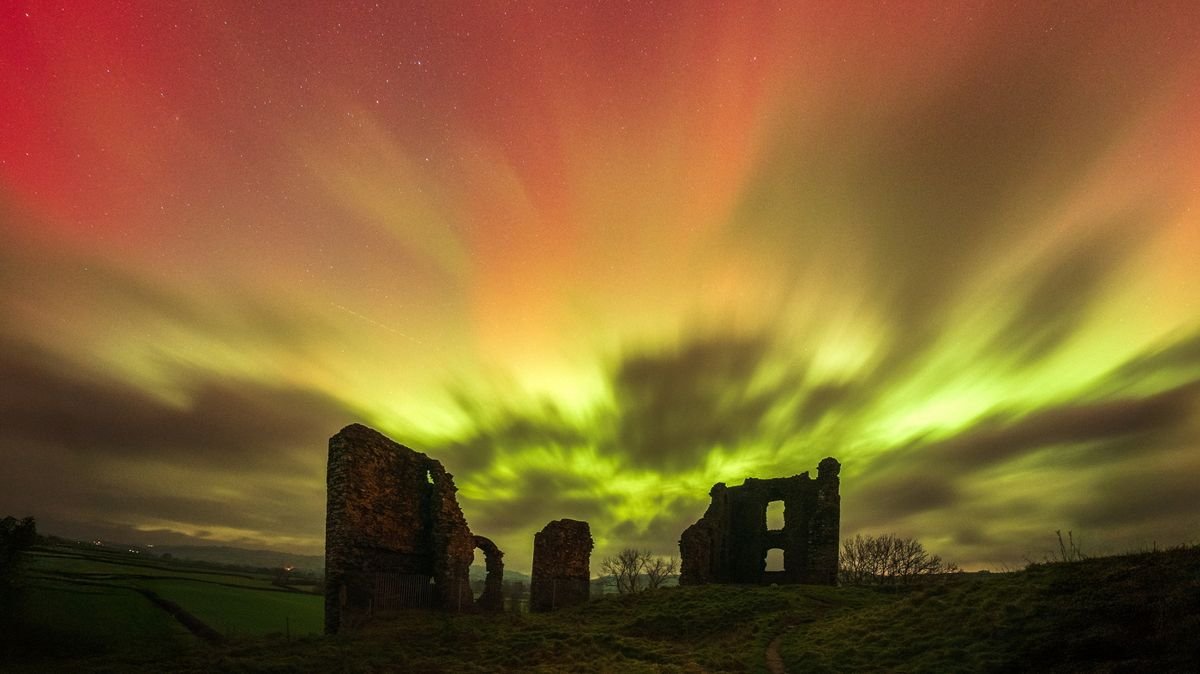

The phenomenon known as the Northern Lights will be visible in the skies of the UK tonight due to a significant solar storm that has occurred. This event has caused the auroras to be seen further south than usual, creating a mesmerizing display of lights.
A strong solar storm, scientifically referred to as a Coronal Mass Ejection (CME), hit the Earth rapidly on Monday, leading to intense auroral activity over the northern hemisphere. The impact of the storm has extended the reach of the Northern Lights, even reaching areas in the US as far south as New Mexico.
The UK has also experienced the effects of this solar event, with regions being illuminated by vibrant red and green hues. The Met Office has identified specific areas where the lights can be observed more prominently.
On Monday, parts of Cornwall, Scotland, and northern England were treated to the sight of the aurora, with Scotland being a familiar location for such occurrences, especially in its northernmost regions. According to the Met Office, similar displays are expected tonight, depending on the prevailing weather conditions.
The Met Office forecasts the arrival of another CME today, with expectations that it will primarily affect the same regions as before. The agency predicts a decline in auroral activity by the evening of January 20 UTC, with potential sightings in parts of Scotland, Northern Ireland, and similar latitudes with clear skies.
Despite the spectacle witnessed on Monday, the Met Office anticipates that the aurora will be best viewed in the northern regions of the UK between 6pm and 11.59pm on Tuesday. Cloudy conditions may limit visibility in parts of Scotland and Northern Ireland.
For the aurora to be visible further south, the solar storm intensity would need to reach a Kp level of 8 or 9, according to the forecasters. However, the current forecast indicates a lower activity level of around Kp7 for tonight, suggesting that the display will remain confined to the north.
The Met Office explains that extreme auroral activity typically requires a Kp level of 8 or 9 and is considered rare, as the natural aurora belt is typically located further north. During moderate to strong geomagnetic storms, the Aurora borealis may extend southwards, with faint visibility in the UK due to their high altitude.
Consider adding Daily Mirror as your ‘Preferred Source’ on Google News to stay updated with the latest news of interest.
At Reach and its affiliated entities, data collected through cookies and other identifiers are used to enhance site experience, analyze usage patterns, and display personalized ads. You can choose to opt out of data sharing by clicking the corresponding button on the webpage. Your use of our website and services indicates acceptance of cookie usage and consent to our Privacy Notice and Terms and Conditions.