

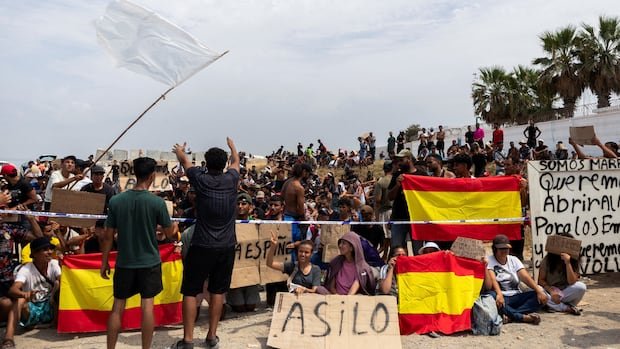

Hundreds of migrants who recently arrived in Ceuta, a North African enclave of Spain, gathered for a demonstration on a popular urban beach, urging Spanish authorities to provide them with asylum instead of returning them to Morocco. These migrants are part of the 5,000 to 8,000 individuals who remain in Ceuta after a large influx two weeks ago, which saw over 72,000 people enter the territory, with the majority voluntarily leaving shortly after.
Due to the city’s strained resources, most migrants are living in challenging conditions on El Trampolin beach or the outskirts of the city while awaiting opportunities to travel to mainland Europe. Ayoub Elarroud from Tetouan, Morocco, expressed their hardship, mentioning that they are enduring harsh conditions sleeping by the sea, suffering from cold and unpleasant odors, and facing restrictions from the police to access the city center.
During the protest, migrants displayed Spanish flags and banners with messages like “We don’t want to go back to Morocco” and “We are also human,” while chanting slogans such as “We’re tired” and “We need a solution.” Some migrants were seen washing clothes or fishing with makeshift bamboo rods on the rocky shores behind the demonstration.
Interior Minister Fernando Grande-Marlaska recently stated that irregularly entered migrants would not be permitted to remain in Ceuta, travel to mainland Spain, or obtain legal status, except in rare cases involving extreme vulnerability. Ceuta’s health services are under immense strain, with limited healthcare workers facing exhaustion, according to Enrique Roviralta, the head of Ceuta’s medical board. He highlighted the emergence of diseases like infectious diarrhea and scabies, along with an increase in violence-related injuries such as broken noses or stab wounds.
Health Minister Monica Garcia refuted claims that local health services had “collapsed” but acknowledged they were under pressure. She emphasized that associating migration with illness is unjust and xenophobic, noting a moderate risk of epidemic outbreaks among migrants and a low risk among residents. Many Moroccan migrants interviewed expressed leaving their country due to poor working conditions, with some holding higher qualifications but struggling financially back home.
The migrants’ stories varied, from seeking better economic opportunities to escaping conflict or persecution in their home countries. Despite facing numerous challenges, these individuals remain hopeful for a brighter future and are determined to secure a stable life in Europe.