

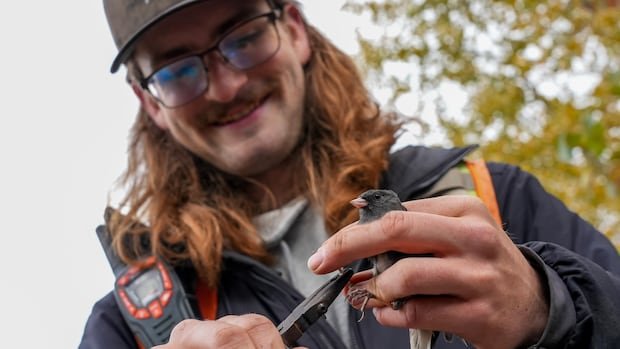

In the midst of a boreal forest, Ethan Denton carefully handles a dark-eyed junco, a small grey songbird, near a network of nets. Denton, an ornithologist from Calgary working in Fort McMurray, Alberta, bands the bird with an aluminum band carrying an identification number on its right leg using pliers. After noting its gender and measurements, he releases the junco, contributing to the collective effort of researchers in North America to track migration patterns.
Ken Foster, a co-founder of the Wood Buffalo Wildlife Research Institute (WBWRI), observes as Denton educates volunteers on the banding process. WBWRI, a unique non-profit organization in Fort McMurray, focuses on long-term bird monitoring in the oilsands region. Foster emphasizes the importance of understanding bird population trends and implementing conservation strategies to combat declines.
The institute’s initiative aligns with existing efforts by organizations like the Oil Sands Monitoring Program and the Alberta Biodiversity Monitoring Institute, as well as various university-led projects. Foster, in collaboration with his consulting company Owl Moon Environmental Inc. (OMEI), established WBWRI as a non-profit entity in 2024 to ensure continuity in wildlife research and engage volunteers in citizen science activities.
OMEI’s data reveals significant declines in certain songbird species, such as the least flycatcher and northern waterthrush, by up to 90% over the past 15 years due to habitat alterations from wildfires and industrial activities along migration routes. In contrast, adaptable ground feeders like clay-coloured sparrows thrive in disturbed habitats, indicating resilience to environmental changes.
Foster acknowledges the support of energy companies for his research and emphasizes the institute’s commitment to enhancing public awareness and education through research projects. WBWRI’s efforts, including bird banding and wildlife monitoring, have attracted enthusiastic volunteers like recent high school graduate Ryan Campbell, who has developed a newfound passion for birdwatching.
Collaboration with experts like biology professor Erin Bayne from the University of Alberta highlights the importance of local studies in identifying regional ecological shifts. By integrating local data into broader databases, researchers can address environmental challenges and inform policy decisions at local and national levels.
Beyond bird banding, WBWRI aims to expand its monitoring efforts to include tracking tower technology for animals with radio transmitters and assessing bat populations’ health. The organization also plans to train volunteers in wildlife rehabilitation to support injured wildlife in the Fort McMurray area.
Foster underscores the significance of initiatives like WBWRI in quantifying environmental changes and addressing declining bird populations, echoing the shared concern for preserving biodiversity.