

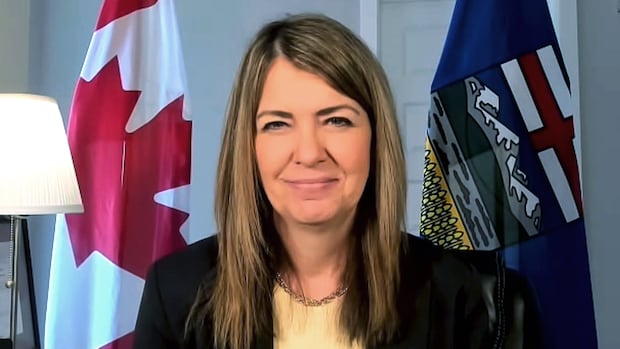

On Saturday, Canadian premiers expressed their discontent with U.S. President Donald Trump’s announcement of 50 percent tariffs on various Canadian imports, but political analysts noted that Alberta’s premier adopted a noticeably different stance from her peers.
While the majority of premiers from different provinces and territories supported Prime Minister Mark Carney’s move to implement equivalent tariffs on U.S. products, Alberta Premier Danielle Smith voiced her concerns during her regular radio segment regarding the potential impacts of a trade conflict on Alberta’s farmers, furniture producers, and beekeepers. She urged both Canadian and U.S. negotiators to resume discussions.
“I understand the emotional inclination to retaliate. However, retaliation means that anyone purchasing products from the United States will now face tariffs of 50 percent or more,” she stated during the 880 CHED program, Your Province, Your Premier.
-
Alberta premier urges return to trade talks, calls U.S. terms ‘untenable’
-
Video
Why Alberta, Quebec are cautious about Carney’s ‘dollar-for-dollar’ tariff stance
Smith’s diplomatic approach is influenced by her desire to maintain favorable relations with the U.S., Alberta’s largest oil buyer, according to political scientist Elizabeth Smythe, professor emeritus at Concordia University of Edmonton.
“The U.S. will continue to import those fossil fuels,” Smythe remarked. “She believes her strategy is the most effective. Whether that aligns with the views of all Albertans is another matter.”
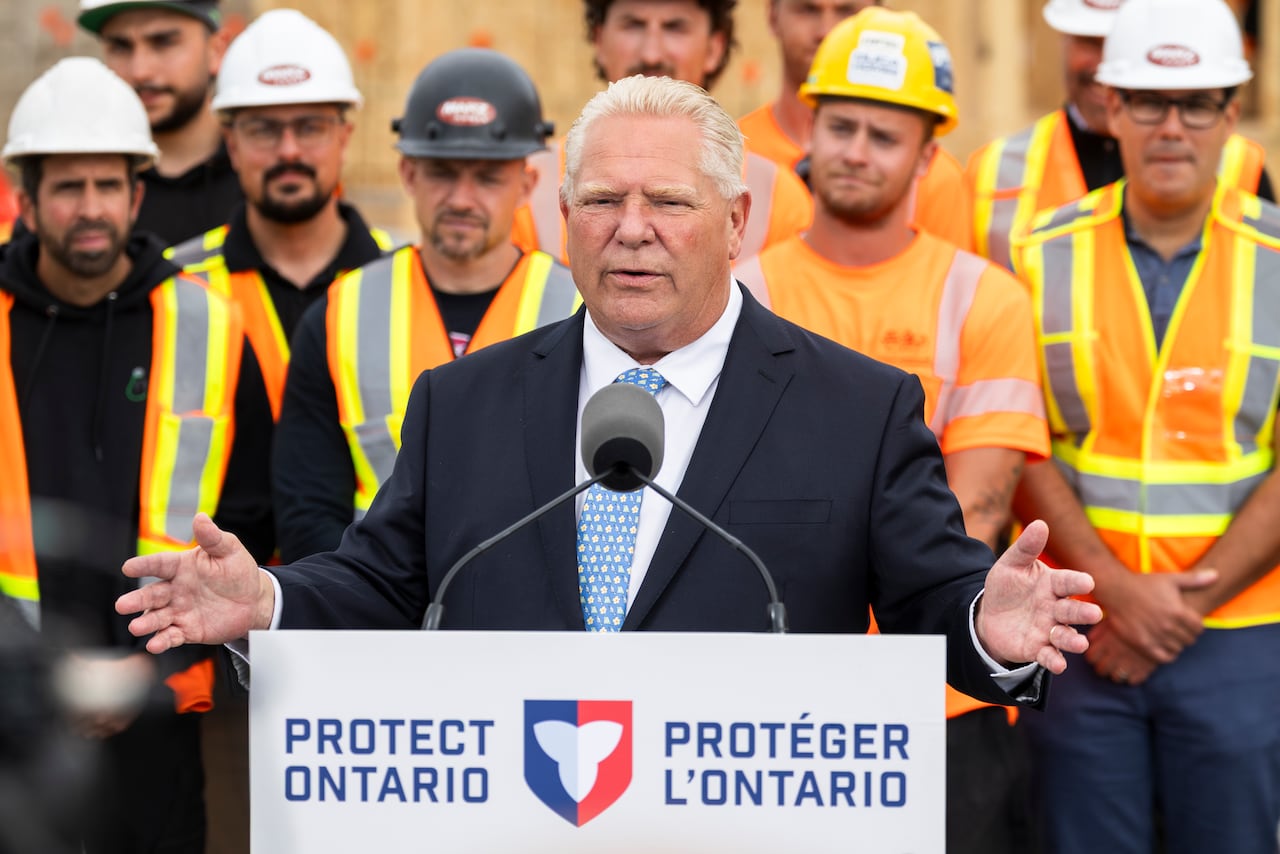
Ontario Premier Doug Ford speaks to media at a housing development in Hamilton on Monday. (Nick Iwanyshyn/The Canadian Press)
On Monday, Ontario Premier Doug Ford expressed his intention to persuade Smith and fellow premiers to consider utilizing any available counter-tariffs to compel the U.S. to reconsider its position.
“It has to be a united Canada effort,” Ford stated during a press briefing in Hamilton. “Everyone must be on the same page, with no dissenters.”
He asserted that if U.S. tariffs were to increase, Canada must be prepared to impose counter-tariffs on oil, gas, and potash exports as a strategy.
“A few premiers hold significant power to safeguard Canada’s interests,” Ford remarked, referencing Smith and Saskatchewan Premier Scott Moe. “I can’t speak on their behalf, but we need full cooperation from Team Canada and to use every possible resource against them.”
Ford and Smith, both conservative leaders and regular allies, had a telephone conversation on Monday afternoon.
In a statement, Smith acknowledged the disproportionately severe impact that the new tariffs would have on businesses in Ontario and expressed her willingness to support initiatives that strengthen the Canadian economy.
However, she noted that reducing energy exports to the U.S. “would be extremely detrimental to Canadians and is not a feasible option,” according to her statement.
Alberta premier in delicate balancing act
Political commentators indicate that Smith’s relatively subdued response to the recent tariffs aligns with her strategy since the onset of the trade conflict last year.
Previously, Smith engaged in a charm offensive in the U.S., including a visit to Trump’s Mar-a-Lago estate in Florida and speaking at events featuring conservative figures, which she claimed were efforts to prevent tariffs.
-
Analysis
Danielle Smith’s fight against Trump tariffs takes her to right-wing non-profit PragerU gala
-
Alberta Premier Danielle Smith visits Donald Trump at Mar-a-Lago
Political analyst Deirdre Mitchell-MacLean from Strathmore, Alberta, points out that Smith’s inner circle struggles to criticize a government they believe aligns with their political views.
“While other premiers are coming out with a more aggressive stance, Danielle Smith is not,” Mitchell-MacLean observed.

Deidre Mitchell-MacLean is a political analyst based in Strathmore, Alberta. (Submitted by Deidre Mitchell-MacLean)
With an impending October referendum regarding Alberta’s status within Canada or the potential for a binding vote on independence, along with polls indicating a majority of Albertans favor national unity, Mitchell-MacLean believes Smith has limited flexibility to adopt a strong position on the matter.
She finds Smith in a precarious situation, torn between a political base that is inclined towards the notion of Alberta independence and the necessity to secure a provincial general election victory in October 2027.
Deron Bilous, a consultant and former minister of economic development and trade in Rachel Notley’s Alberta NDP government, noted that there is minimal political risk for the Ontario premier to suggest counter-tariffs that would have little adverse effect on his province.
“It’s quite simple to negotiate with someone else’s resources, which is precisely what Doug Ford is doing,” Bilous stated.
He emphasized that imposing tariffs on oil and gas exports would have “massive” consequences in Alberta, potentially resulting in a multi-billion dollar deficit in the provincial budget and halting the industry’s expansion or investment strategies.
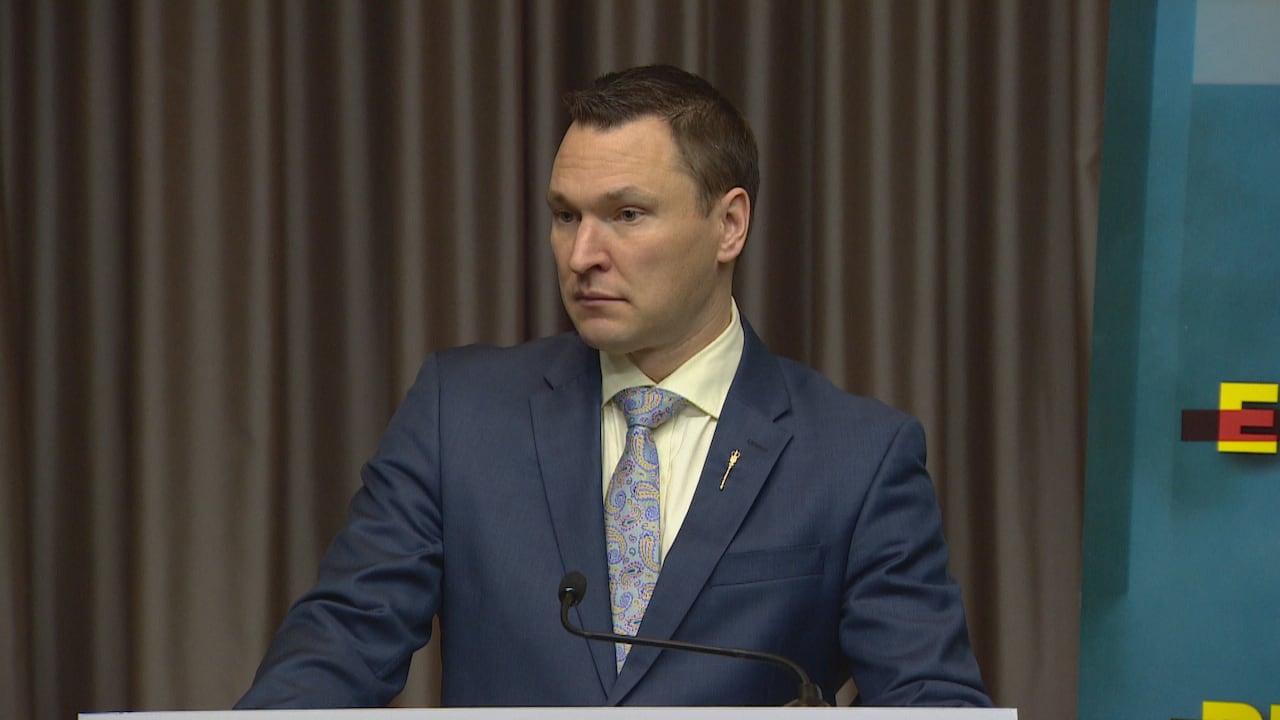
Deron Bilous was a cabinet minister in Rachel Notley’s Alberta NDP government from 2015 to 2019. (Emilio Avalos/CBC)
While oil tariffs could serve as Canada’s strongest leverage, Bilous raised concerns about the timing of using that leverage when Alberta is so dependent on the U.S. as a market. He suggested that Smith is aware of this reality, which contributes to her hesitation to endorse such actions.
Bilous supports Carney’s decision to pursue alternative counter-measures against Trump.
“Bullies only respond to those who confront them,” Bilous remarked. “And the danger in refraining from imposing any counter-tariffs is that it may portray Canada as weak.”
Evan Menzies, vice-president of Crestview Strategy, who has experience with both the United Conservative Party and the former Wildrose Party, stated that Smith’s diplomatic strategy has been successful thus far, as Alberta’s exports appear to be less impacted by U.S. tariffs.
He highlighted that the provincial leader must foster positive relationships with any U.S. administration due to the significance of the American market.
Separation referendum is a bigger risk: analysts
While Ford contends that a lack of cohesion among Canadian premiers poses a risk in U.S. trade discussions, the analysts consulted by CBC News on Monday expressed greater concern regarding the upcoming October 19 referendum as a potential vulnerability that Trump could exploit.
On October 19, Alberta voters will participate in a referendum covering ten questions, including one regarding initiating a process for a binding vote on becoming an independent nation.
“The timing is certainly awkward,” Menzies acknowledged, noting that Smith has made it clear she will advocate for Alberta’s continued presence in Canada.
Bilous added that the subtleties of the situation are irrelevant to investors, who tend to avoid uncertainty.
“If the perception is that there is uncertainty about Alberta’s status within Canada, it will immediately affect economic development and investment attraction,” he explained.
As the trade war with the United States rages on, many of Canada’s premiers are rallying behind Prime Minister Mark Carney. Alberta’s leader is taking a different path. As CBC’s Sam Brooks reports, some commentators believe Danielle Smith is walking a political tightrope.
Political scientist Smythe suggested that Smith’s strategy may present her as a sympathizer of Trump.
“She already faces skepticism regarding her stance in this referendum,” Smythe noted. “She professes to favor remaining in Canada. Yet, if she appears too weak in her efforts to advocate for Canada against the U.S., it could be problematic.”
The Alberta NDP did not provide a spokesperson for an interview on Monday but is set to hold a news conference in Calgary on Tuesday to demand action from the government in response to what they term Trump’s latest affront to Canadian sovereignty.
“Danielle Smith has authorized a separatism referendum to protect her political interests from her own separatist supporters,” NDP leader Naheed Nenshi stated in a separate email. “This has weakened Canada’s position in front of Trump and the entire world.”
The Opposition is organizing a “Rally the Vote for Canada” campaign to motivate voters to support Alberta’s continued presence in Canada.