

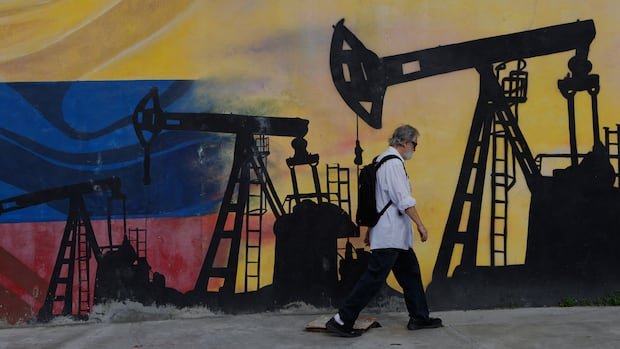

The White House has provided limited details regarding what President Donald Trump has referred to as the “BIGGEST OIL DEAL IN WORLD HISTORY” in Venezuela, apart from a social media post by the president. Trump announced that the agreement revealed on Friday night would grant the United States a share in Venezuela’s extensive oil reserves, aligning with his objective of tapping into the country’s energy resources following the capture of then-president Nicolás Maduro by American forces in January.
Acting president of Venezuela, Delcy Rodríguez, characterized the deal as a crucial step towards economic recovery and the modernization of the nation’s oil industry. However, key questions such as the timeline for drilling the reserves and the financing of the operation remain unanswered as no formal agreement text has been made public.
The terms of the deal entail the formation of a new private company by the U.S. government and an undisclosed Venezuelan entity, granting rights to vast untapped oil fields for a century. Rodríguez’s statement indicated the development of 17 fields with a proven reserve potential of 65 billion barrels, projecting a substantial influx of $100 billion US in investments into Venezuela’s oil sector and an estimated $209 billion US in tax revenue for Caracas.
The agreement was brokered by U.S. Secretary of State Marco Rubio, Defence Secretary Pete Hegseth, and Rodríguez, giving the U.S. a 55% share of the new company’s effective output, inclusive of ownership rights and the option to purchase oil at cost. The company is poised to become the second-largest corporate holder of proven reserves worldwide, trailing only Saudi Aramco.
Despite Trump’s assertion that the deal could lead to lower gas prices for Americans, experts caution that Venezuela’s deteriorated oil infrastructure necessitates extensive repairs and substantial investments, implying that any production surge is likely to be gradual. The long-term implications for Canada’s oil industry remain uncertain, with potential impacts on competition in the North American heavy crude market and the need for Canada to diversify its energy trade partners beyond the U.S. market.
Key aspects such as the identity of the private operator, funding responsibility for infrastructure upgrades, and the breakdown of America’s ownership stake in the company are yet to be clarified. The reception of big American oil companies to re-enter the region remains uncertain, given the political instability and infrastructure challenges in Venezuela. Notably, Chevron, the sole active U.S. oil producer in Venezuela, declined to comment on the deal, while Exxon Mobil refrained from providing a statement.