

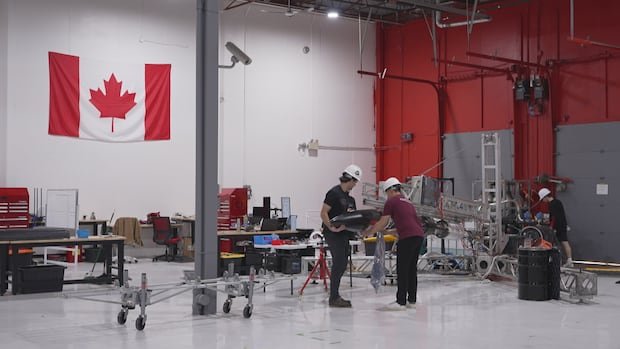

Canada, as the only G7 nation lacking its own space launch capabilities, is actively pursuing the development of a Canadian-made rocket. Several Canadian companies are in a race to provide the country with its own means of reaching space promptly. This effort coincides with concerns among some customers of SpaceX that the industry leader may reduce its frequency of orbital launches.
The Canadian rocket companies are facing the challenge of completing a costly endeavor within tight deadlines and amidst evolving governmental priorities, making the journey to space complex. Due to Canada’s current inability to launch rockets domestically, customers in the country, including private entities and government agencies, rely on external sources to deploy their satellites into orbit. SpaceX, particularly, has been a major player in launching Canadian satellites, having sent up all 12 Canadian satellites in 2025 according to SpaceQ, a Canadian space publication.
These satellite technologies play vital roles in various applications such as telecommunications, military operations like threat detection, and earth observation tasks like tracking wildfires. Marc Boucher, the founder of SpaceQ, emphasizes the critical nature of these technologies and highlights the risk of foreign entities potentially refusing to launch Canadian tech if Canada lacks control over its own launches.
Recently, the Canadian government identified space as a key sovereign capability in its Defence Industrial Strategy and introduced legislation in April to potentially authorize launches from Canadian soil. Funding has been allocated, including $8.3 million to each of three Canadian companies working on rockets as part of a multi-year initiative aimed at achieving light-lift rocket capabilities by 2028.
Among these companies is NordSpace, established in 2022, which focuses on satellite and space technology development, including building rockets and launch infrastructure. While their initial suborbital rocket test in 2025 was unsuccessful, they plan to make another attempt soon. Another player, Reaction Dynamics, has been working on a unique engine design since 2017, with both companies aiming to reach orbit by 2028 in alignment with government objectives.
Canada Rocket Company, the newest entrant, aims to develop a medium-lift rocket capable of carrying multiple satellites into low Earth orbit simultaneously. With plans for a first launch in 2032, the company has attracted private investments and is building a $30 million test facility in London, Ontario, to support its development efforts.
The potential scaling back of SpaceX’s Falcon 9 rocket as the company transitions to the larger Starship vessel poses concerns for customers reliant on SpaceX for satellite launches. This shift could present opportunities for emerging rocket manufacturers to capture market share left by SpaceX. Canadian satellite communications company Kepler, for instance, has launched most of its satellites using the Falcon 9.
CEO Mina Mitry, an advisor to Canada Rocket Company, anticipates that SpaceX competitors like Rocket Lab could help meet the demand for satellite launches. However, smaller players relying on SpaceX’s rideshare program may face challenges with reduced access. Mitry underscores the importance of having a Canadian rocket manufacturer, especially with SpaceX’s Falcon 9 phaseout.
In conclusion, the development of a Canadian rocket industry presents both challenges and opportunities. The sector requires substantial funding and time for testing and development, with a long-term outlook necessary for success. The efforts of Canadian rocket companies are crucial for achieving space launch sovereignty and reducing dependence on external launch providers.