

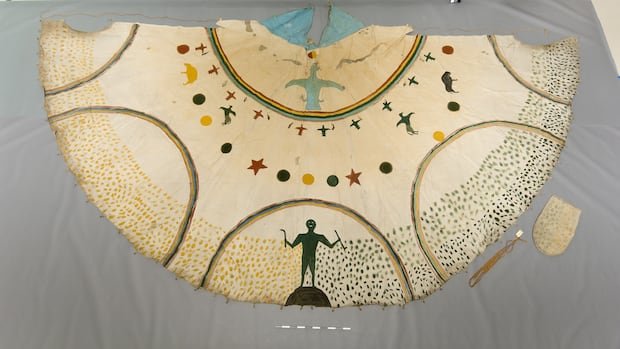

A professor from Saskatchewan unearthed a historical artifact from the Smithsonian in Washington, D.C., related to the province’s past. The artifact, a teepee cover stolen from Kawacatoose First Nation around a century ago, was spotted by Andrew Miller, an Indigenous studies professor at the First Nations University of Canada, while researching birds using the Smithsonian’s collection.
The cover, taken during the 1920s, had been kept alive in memory by the family through generations. Miller, recalling a student’s mention of belongings in U.S. museums, identified the teepee cover in the catalogue labeled “Dustyhorn—File Hills,” dated 1926. Knowing Dustyhorns in Touchwood, Saskatchewan, Miller contacted Cory Dustyhorn, the current chief of Kawacatoose First Nation, to share his discovery.
Dustyhorn confirmed the story of his great-great-grandfather Sîpiskwêsîkan’s stolen teepee cover, promised payment but never received. Miller and Dustyhorn engaged with the Smithsonian, which showed understanding and openness to repatriating the artifact, ensuring it returned to the rightful community.
The Smithsonian acknowledged past unethical acquisitions facilitated by Indian Agents acting as intermediaries. In 2022, the museum adopted a policy for shared stewardship and ethical returns, recognizing changing norms in collecting practices. After a century, the teepee is set to return to its community, strengthening ancestral connections for Dustyhorn and his people. Plans include displaying the teepee in a museum at Kawacatoose, with temporary housing at the Royal Saskatchewan Museum in Regina.