

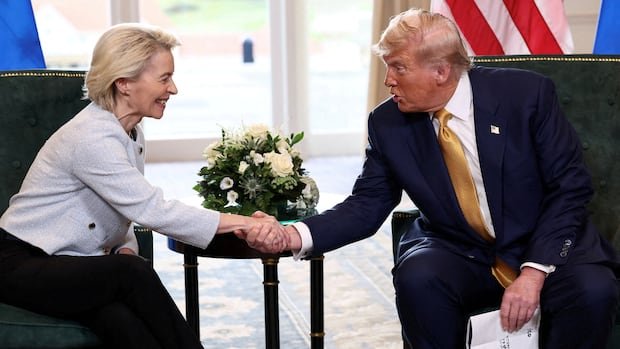

During a visit to Donald Trump’s Turnberry golf resort in Scotland last year, European Union chief Ursula von der Leyen assured Europeans that agreeing to a flat 15% U.S. tariff on EU exports would provide the continent with “predictability and stability.”
Critics now view the trade agreement as a one-sided surrender that has led to continuous American economic pressure tactics.
Initially, the U.S. sought to reclassify specific European industrial goods to enforce higher tariffs. Currently, a new dispute has arisen over Europe’s attempt to impose a digital services tax on U.S. tech giants, mirroring Washington’s recent efforts to dictate tax terms to Ottawa.
Shortly after the European Parliament ratified the Turnberry deal, Trump took to Truth Social, threatening to impose 100% tariffs on any European country that enforces or expands tech taxes, potentially overriding the entire agreement.
As European opposition to Trump’s demands grows stronger, some lawmakers are viewing Mark Carney’s bold exit from the U.S. trade negotiations not as a reckless move but as a lesson in standing up to intimidation.
Former French ambassador to the U.S., Gerard Araud, stated that “Canada should lead the way for the EU: only firmness pays off with Trump.”
“Countries upholding democracy and the rule of law â and rejecting lawlessness â must collaborate,” wrote Bernd Lange, a German parliamentarian who heads the EU’s trade committee, on X. “We stand by Canada’s side.”
Former Swedish Prime Minister Carl Bildt suggested, “With Canada, China, and Brazil demonstrating the ability to confront the United States in trade discussions, the EU and Japan may question if they made the right choices.”
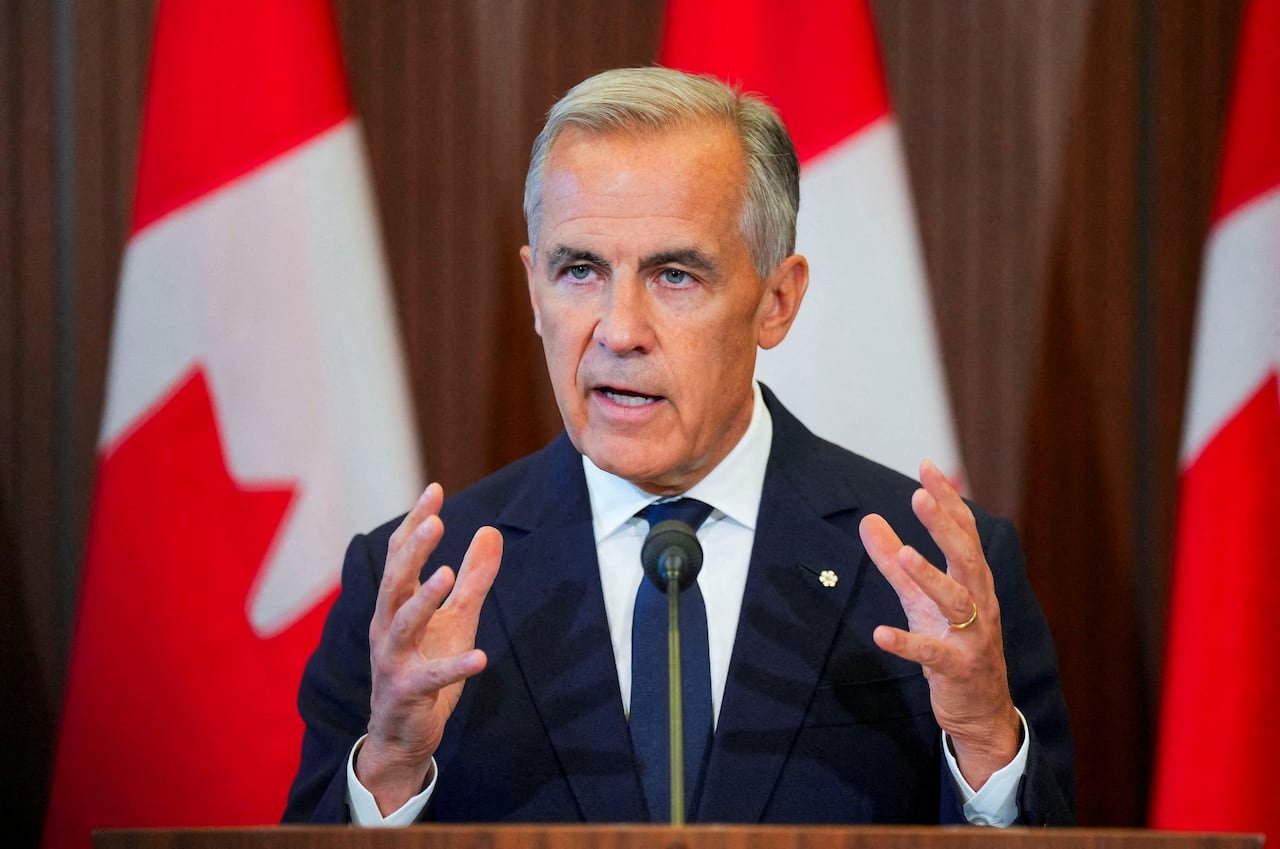
Quiet endorsement
Currently, a “discreet” approach seems prevalent.
Most of Europe’s current leaders have refrained from openly defending Carney in the trade dispute, likely to avoid provoking Trump’s anger.
However, observers acknowledge that behind closed doors, Canada’s strategy is held in high regard.
“Canada’s decision to walk away signifies that one doesn’t have to accept everything,” said Tobias Gehrke, a senior policy fellow with the European Council of Foreign Relations.Â
“Being ready to walk away and intensify pressure on Washington can lead to better outcomes.”

Thus far, Europe has only firmly opposed Trump over territorial matters, not trade.
Trump’s attempts to pressure Denmark into surrendering Greenland to the U.S. triggered widespread EU condemnation, U.S. diplomatic isolation, and a modest Danish and European military response.
Only when