

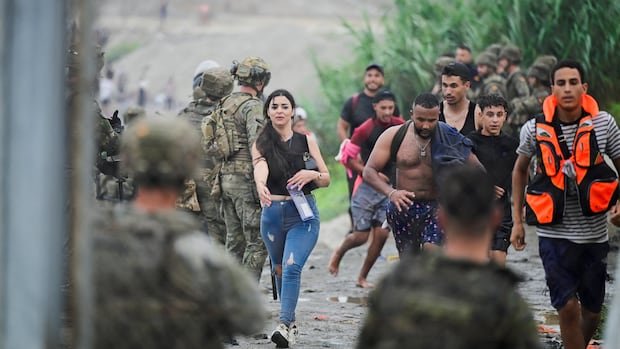

Spain and Morocco have strengthened the border fence of a Spanish enclave, effectively reducing mass crossings after a significant influx of people by sea and land. Approximately 57 individuals have lost their lives during this period, with around 60,000 individuals entering Ceuta recently, as reported by Juan Jesus Vivas, the leader of the Spanish enclave in North Africa.
By 6 p.m. local time on Friday, an estimated 48,300 migrants had voluntarily returned to Morocco, according to information from Spain’s Interior Ministry. The sudden surge of migrants into Ceuta, a small Spanish territory protruding into the Mediterranean from Morocco, has caused concern and discord in Europe. France announced increased border checks with Spain, while Italy threatened to suspend Spain from the European Union’s open border scheme.
Moroccan authorities deployed water cannon trucks and used force, including batons and tear gas, to push back individuals attempting to cross into Ceuta. The aftermath of clashes included a bus and seven cars in charred condition near the border. Spanish authorities are aiming to swiftly expel those who entered illegally, despite legal limitations on immediate expulsions due to recent court rulings.
Spanish Prime Minister Pedro Sanchez condemned the mass crossings as a violation of Spain’s territorial sovereignty. He urged Morocco to intensify efforts to curb the flow of people. Ceuta and Melilla, another Spanish city in northern Morocco, have the only land borders with Africa in the European Union, experiencing periodic surges in migration attempts.
Various factors, including a recent ruling by Spain’s Supreme Court regarding migrants intercepted at sea en route to Ceuta or Melilla, are believed to have contributed to the recent surge. Migrants often swim from Moroccan towns like Fnideq to reach Ceuta, covering approximately five kilometers, while others attempt the crossing from nearby areas.
Despite a reinforced security presence on the Moroccan side of the border, some migrants managed to enter Ceuta. However, groups sought alternative routes along the coast to bypass the fence. Migration remains a sensitive issue in Europe, with right-wing parties gaining popularity in response to past migration crises.
European nations are responding to the situation, with France pledging increased police presence on its border with Spain and Germany expressing support for Spain’s stance on illegal migration. Italy’s Prime Minister emphasized the need to defend borders and citizens, hinting at potential measures, including suspending the Schengen Area with Spain.
In the U.S., President Donald Trump criticized the situation as resembling an invasion and warned of similar events if certain political changes did not occur. Despite the challenges posed by illegal crossings, Spain’s government acknowledges the economic contributions of immigrants and has implemented initiatives like mass amnesties to integrate them into society.
The recent events in Ceuta have sparked international debate, with Italy’s Foreign Minister criticizing Spain’s citizenship grant policies, prompting a response from Spain’s Foreign Minister calling for solidarity over political rhetoric.