

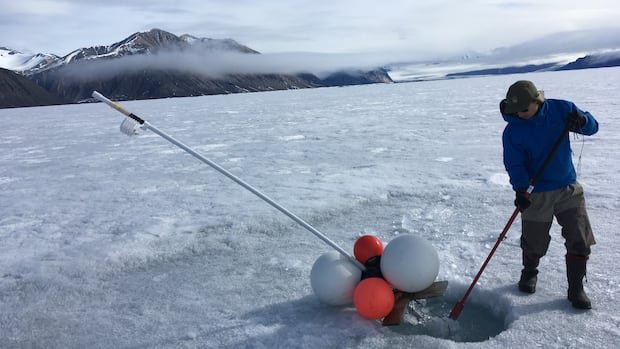

In a recent study, scientists have confirmed the disappearance of Canada’s last remaining epishelf lake, which was a unique freshwater body floating on saltwater and supported a distinct ecosystem. The Milne Fiord epishelf lake on Ellesmere Island in Nunavut, considered as the final one of its kind in Canada, has vanished, leaving behind the loss of its diverse life forms.
Lead author Jérémie Bonneau, an assistant professor at Laval University in Quebec City, expressed sadness over the disappearance of the lake, emphasizing its significance as the sole remaining example in Canada. The event underscores the impact of a warming climate on the Arctic region, highlighting a significant shift caused by the loss of this 4000-year-old ecosystem.
Although previous reports had mentioned the demise of the lake, a recent study published in Scientific Reports provides a detailed account of the lake’s disappearance process, marking it as an irreversible event that signifies the end of a long-standing era. The study sheds light on the mechanisms leading to the lake’s disappearance and the broader implications of its loss.
Epishelf lakes, a rare phenomenon, are typically formed when freshwater accumulates on top of saltwater due to natural barriers like ice shelves. The Milne Fiord lake, shielded by the Milne Ice Shelf for millennia, had a unique structure that allowed distinct freshwater and saltwater ecosystems to coexist within the same body of water. The lake’s environment supported a diverse range of microorganisms, including bacteria, viruses, and phytoplankton, with minimal overlap between the two ecosystems.
The collapse of the Milne Ice Shelf in 2020 led to the lake’s draining, causing the irreversible mixing of freshwater and saltwater and resulting in the immediate loss of the lake’s inhabitants. The disappearance of the lake has significant ecological implications, with its former role in sustaining a flourishing ecosystem now altered by the shift to a more typical marine environment in the saltwater fiord.
While epishelf lakes are no longer present in Canada, similar formations still exist in Greenland and Antarctica. Scientists warn that these unique ecosystems are under threat globally due to environmental changes, emphasizing the need for conservation efforts to protect the planet’s diverse and fragile ecosystems for future generations.
The research findings highlight the profound impact of climate change on delicate Arctic ecosystems and serve as a reminder of the urgent need for sustainable practices to preserve the Earth’s natural wonders.