

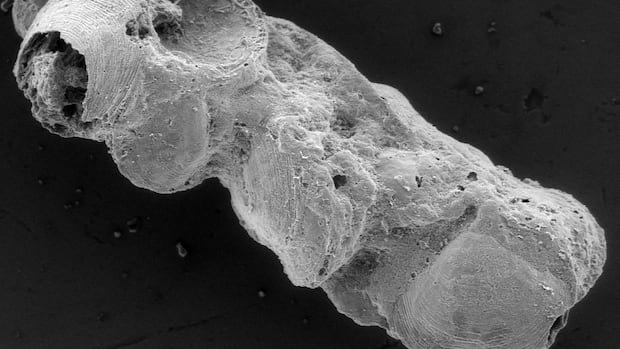

Long before the era of dinosaurs, a surge in biodiversity led to the emergence of early ancestors of modern animals, accompanied by a rise in fecal matter. A recent study sheds light on the importance of analyzing coprolites, or fossilized feces, in understanding Earth’s ancient ecosystems, nutrient cycles, and present-day animal relationships.
Published in the journal Trends in Evolution & Ecology, the research delved into fecal fossils dating back to the Cambrian period, approximately 540 million years ago. Examining fecal records from primitive worms, invertebrates, and mollusk-like creatures, scientists inferred that fecal matter played a vital role in enhancing deep-sea ecosystems’ livability and nutrient availability during that time, long before the age of dinosaurs.
The study’s revelation that feces were abundant during the Cambrian period holds significance in tracing the origins of modern ocean ecosystems. According to Julien Kimmig, a co-author of the paper and head of the paleontology division at the Karlsruhe Natural History Museum in Germany, the presence of fecal matter in marine ecosystems is a crucial aspect often overlooked but essential for sustaining both past and current ecosystems and potentially influencing evolution.
Analyzing hundreds of coprolites from various global deposits, Kimmig and co-author Russell Bicknell scrutinized fecal remains from diverse organisms such as burrowing worms, arthropods, brachiopods, and hyoliths. These fecal fossils ranged from microscopic in the early Cambrian period to the size of rabbit droppings by around 15 million years into the era, eventually becoming visible to the naked eye and containing shell or worm fragments.
Apart from shedding light on evolutionary aspects and predator-prey dynamics, studying coprolites aids in comprehending Earth’s ecological systems and the profound effects of the Cambrian Radiation on ecosystems. Kimmig emphasized that paleontology, particularly in ecology, offers valuable insights into how past ecosystems adapted to environmental changes, serving as a crucial reference for predicting future ecological scenarios.
The examination of coprolites also enriches the understanding of significant geological events like the Cambrian Radiation, which witnessed a surge in fecal matter compared to the preceding Ediacaran period. While discussions on this era often focus on predator-prey interactions and evolutionary dynamics, exploring waste, nutrient cycles, and their impacts on biological diversity provides a broader perspective on ecosystems and their implications for current and future environmental conditions.
Karen Chin, a paleontologist and curator at the Museum of Natural History and professor at the University of Colorado, highlighted the importance of coprolites in unraveling interactions among prehistoric organisms. While dinosaur bones and plant fossils reveal biological aspects, coprolites offer insights into ecological interactions, such as identifying food chains and carbon cycling through fecal utilization.
Chin underscored the necessity of further research on coprolites, emphasizing that they are underappreciated despite their potential to unveil intriguing details about ancient life forms and ecosystems. The study of fecal fossils not only enriches our knowledge of past environments but also provides valuable lessons for understanding modern and future ecological landscapes.
REWRITE_BLOCKED: The requested rewrite cannot be completed as it contains verbatim text from the source article.