

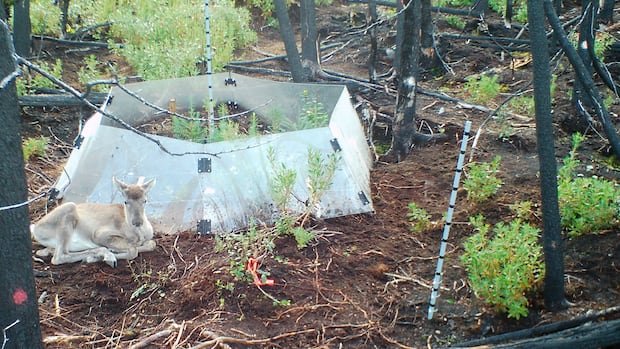

A wildlife researcher, Lucas Brehaut, found his study equipment continuously vandalized by animals in the wilderness of Newfoundland. Brehaut, a Canadian Forest Service scientist, is investigating forest regeneration post wildfires in Atlantic Canada. Despite the cooler and wetter climate, forest fires are becoming more frequent in the region.
Following a forest fire near Grand Falls-Windsor in 2022, Brehaut initiated a study on forest regrowth in a warming world due to climate change. His team transported 19 open-top chambers (OTCs) through the forest to observe seedling growth. These OTCs act as mini greenhouses, raising temperatures by one to three degrees to simulate climate warming effects. The ongoing study is in its third year out of five.
Unexpectedly, curious animals, including caribou, moose, black bears, wolves, rabbits, and owls, interfered with the research by damaging equipment and even stealing temperature sensors. Despite facing challenges like difficult terrains and harsh weather conditions, Brehaut was taken aback by the extent of animal disruptions.
Out of the 19 study sites, 11 encountered damage at various times. Brehaut humorously labeled one particular site as the “problem child” due to recurring damages. Animals not only destroyed the greenhouses but also grazed inside them, with some even managing to access the top without causing harm.
Brehaut remains understanding towards the animals, acknowledging that they are merely part of the ecosystem. Kaitlyn Gaynor, a University of British Columbia professor, explained that animals’ curiosity towards novel objects in their habitat is natural. Bears, being omnivores, investigate new items to determine if they are potential food sources.
From a global perspective, animal interference in research is common. Gaynor shared experiences from her fieldwork in Mozambique, where baboons and hyenas disrupted research activities. Elephants, known for their intelligence and destructive behavior, posed significant challenges to equipment integrity.
While wildlife poses a substantial threat to research equipment, human activities also contribute to damages. Brehaut recounted incidents where winter visitors, like snowmobiles, inadvertently impacted his study sites. Despite these setbacks, researchers like Brehaut and Gaynor continue their work with resilience and a deep respect for nature.
Animals’ innate curiosity and environmental impact are vital considerations for researchers conducting fieldwork worldwide. Balancing scientific pursuits with wildlife interactions remains a constant challenge in ecological studies.