

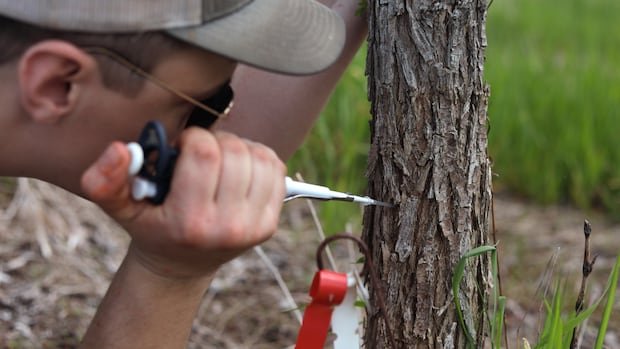

Scientists in Vermont have been conducting a unique experiment this summer by intentionally infecting thousands of trees with Dutch elm disease. The researchers, collaborating with the U.S. Forest Service and the Nature Conservancy, are testing a new generation of elms bred from disease-resistant survivors to determine their potential resistance to the fungus transmitted by bark beetles. The ultimate objective is to revive the once abundant elm populations that used to adorn city streets and riverbanks.
Gus Goodwin, a senior conservation planner at The Nature Conservancy, expressed concern over the devastating loss of elm trees in recent years due to Dutch elm disease. The experiment aims to develop elm varieties that can withstand the disease, offering hope for restoring elm populations in regions facing the threat of the fungus.
In Canada, efforts are also underway to combat Dutch elm disease, with the Elm Recovery Project at the University of Guelph leading similar initiatives. Alison Morrison, a project manager, highlighted the importance of preserving elm trees’ resistance to the disease to ensure their long-term survival in the face of the growing threat.
The Dutch elm disease outbreak in the 1960s and 70s significantly impacted eastern Canada, leading to the loss of thousands of elm trees in cities like Fredericton, once known as the “City of Stately Elms.” Anthony Taylor, a forest management professor at the University of New Brunswick, has witnessed the disease’s devastating effects on elm trees, emphasizing the urgency of finding solutions to protect these iconic trees.
The disease, spread by bark beetles carrying spores, attacks the elm’s vascular system, leading to water deprivation and eventually tree death within a few years of infection. To curb the spread of Dutch elm disease, infected trees are promptly removed, although past practices of removing healthy elms unintentionally reduced the population of disease-resistant trees.
As cities across Canada face new threats from Dutch elm disease, including Edmonton and Saskatoon, municipal authorities are taking proactive measures to combat the spread of the fungus. Residents are urged to comply with tree pruning regulations and avoid activities that facilitate the disease’s transmission, such as storing or burning infected wood.
Despite the challenges posed by Dutch elm disease, researchers are optimistic about developing elm varieties that can coexist with the fungus, similar to European elms. The ongoing experiments in Vermont and Canada aim to produce disease-resistant elm trees that can thrive in urban environments, contributing to biodiversity and climate change resilience.
The long-term goal of these initiatives is to cultivate elm populations that can withstand Dutch elm disease, ensuring the preservation of these iconic trees for future generations. The collaborative efforts of scientists, foresters, and conservationists offer hope for a future where elm-lined streets and landscapes can once again flourish.