

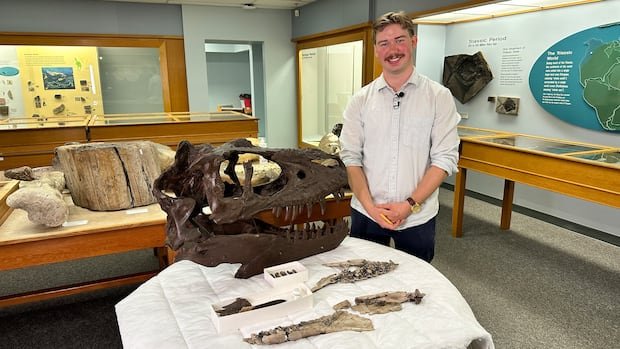

Researchers from the University of Alberta have uncovered a startling revelation that suggests a raptor dinosaur may have feasted on a much larger tyrannosaur in ancient times. In a recent study, scientists identified bite marks on the jaw of an Albertosaurus, a close relative of the iconic Tyrannosaurus rex, which inhabited the Alberta region approximately 70 million years ago.
The fossil in question belonged to an eight-year-old Albertosaurus that had not yet reached full maturity. The presence of these bite marks prompted researchers to consider two possible scenarios regarding the fate of the dinosaur after its demise near Drumheller, Alberta, located around 130 kilometers northeast of Calgary.
The prevailing theory proposes that a raptor, a smaller carnivorous dinosaur with two legs, likely scavenged on the larger Albertosaurus after its death from unknown causes. Philip Currie, a renowned professor of dinosaur paleobiology at the University of Alberta, described this finding as a rare instance where evidence of one carnivore consuming another is documented.
The discovery is significant as it sheds light on the interactions between carnivorous dinosaurs and the complexities of the prehistoric food chain. Joshua Doyon, a master’s student specializing in paleontology at the University of Alberta, spearheaded the research into the bite marks. By analyzing the spacing between the marks and comparing them with the teeth of contemporary carnivorous dinosaurs, the researchers concluded that a raptor was the most likely culprit.
Alternatively, there is a hypothesis suggesting that the Albertosaurus may have been cannibalized by a much younger member of the same species, estimated to be under two years old and about two meters in length.
The fossil containing the bite marks was initially discovered in 2022 by a member of the public exploring the badlands north of Drumheller. Following the find, the Royal Tyrrell Museum recovered and meticulously prepared the specimen, leading to Doyon’s research project in 2023.
Doyon expressed his interest in studying dinosaur behavior and species interactions, indicating that this specimen provided a unique opportunity to investigate a feeding event that occurred millions of years ago. Currie emphasized the importance of examining intricate details on fossils to enhance our understanding of dinosaur biology and prehistoric ecosystems.
The findings underscore the significance of uncovering rare evidence of one carnivorous dinosaur preying on another, as opposed to herbivorous prey. While the term “raptor” may evoke images from popular culture like the Jurassic Park films, the actual raptors found in Alberta, specifically the Atrociraptor species, were notably smaller than their cinematic counterparts, akin in size to a German shepherd.
Doyon hopes that both paleontologists and the general public will pay closer attention to subtle tooth marks on dinosaur bones, as they may reveal intriguing insights that might otherwise go unnoticed.