

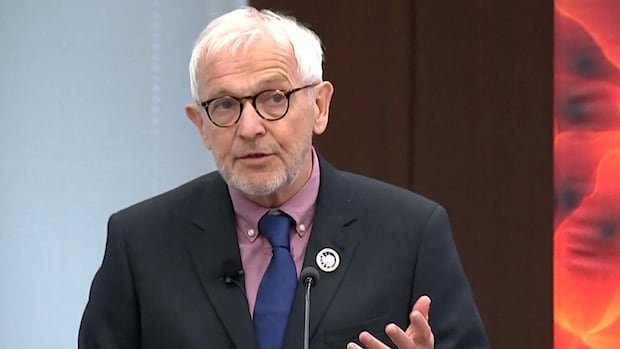

Belgian-American physicist Francis Halzen, aged 82, was named the recipient of the 2026 Nobel Prize in Physics on Tuesday in Stockholm. The prestigious award recognized his significant contributions to the IceCube Neutrino Observatory and the detection of high-energy neutrinos of astrophysical origin. The observatory, positioned at the Amundsen–Scott South Pole Station in Antarctica, was pivotal in this groundbreaking discovery.
Halzen’s innovative idea to utilize ice at the South Pole for neutrino tracking, particles known as “ghost particles” for their ability to traverse the Earth and matter without leaving a trace, was a game-changer in the field of particle physics. These neutrinos act as messengers from the cosmos, offering insights into distant galaxies and the phenomena of celestial bodies like exploding stars.
Each year, the Nobel Physics Prize recipients are chosen by the Royal Swedish Academy of Sciences, receiving a substantial award of 12 million Swedish crowns ($1.7 million Cdn). The IceCube Observatory, covering an entire cubic kilometer, commenced operations in 2011, materializing a vision that originated in the late 1980s.
Halzen expressed his gratitude to his collaborators over the years, acknowledging the skepticism surrounding the project’s success at its inception. Affiliated with the University of Wisconsin-Madison in the U.S., Halzen was elated and surprised by the Nobel recognition while attending a conference in Italy.
Neutrinos, elusive cosmic particles with minuscule mass, play a crucial role in unraveling the mysteries of the universe. Halzen’s research focused on a unique group of neutrinos considered cosmic messengers, shedding light on the evolution of the universe.
The IceCube Observatory is slated for an extension known as IceCube-Gen2, covering eight cubic kilometers of ice, set to be operational in 2033. This expansion aims to enhance neutrino detection capabilities, including the identification of weaker neutrinos.
As Halzen looks ahead, he anticipates further discoveries that could revolutionize our understanding of the universe. Belgian Prime Minister Bart De Wever commended Halzen’s dedication to exploring the cosmos through the study of neutrinos.
The Nobel Prize in Chemistry, literature, peace, and economics will be revealed in the upcoming days, with the laureates receiving their honors on December 10, commemorating Alfred Nobel’s legacy as the pioneer of the prestigious awards.