

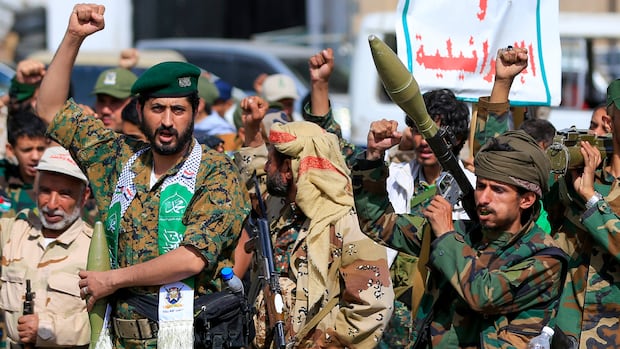

On Saturday, Iraq’s government was urgently working to manage the repercussions following accusations that local militias, backed by Iran, had attacked and closed a significant pipeline belonging to Saudi Arabia.
While a coalition of Iran-aligned militias in Iraq denied any involvement, the Iraqi government acknowledged that the assaults had indeed originated from its territory. The government committed to conducting an investigation and dismissed a military leader.
Increasing pressure is mounting on Iraq to curb local militias from supporting other Iranian proxy factions throughout the region. The Iraqi administration has imposed a deadline of September 30 for non-state actors to disarm, but several of the most influential militias have stated they will not comply.
The urgency to disarm these militias has intensified as the Iran-backed Houthi rebels make significant advances along Yemen’s western coast, presenting a serious challenge to the Saudi-backed coalition, which risks escalating regional conflict. On Friday, the Houthis took control of an island in the Bab al-Mandab Strait, a crucial shipping route accounting for approximately 12 percent of global trade.
The Houthis’ effective control over the strait could lead to soaring global oil prices—already elevated due to the six-month-long conflict between Iran and the U.S. The strait has become a critical shipping lane for Saudi oil, particularly since the Iran conflict has disrupted transportation in the Strait of Hormuz.
During a press conference in Dublin on Saturday, U.S. President Donald Trump suggested that Iran was “probably” behind the pipeline incident while attempting to alleviate concerns.
He mentioned that his administration had “engaged in discussions” with the Houthis, though he did not clarify which talks he was referring to.
“The Houthis reached out to us, and they are not looking to engage in conflict with us,” Trump noted. “They would prefer to avoid our involvement and are allowing most vessels to pass through.”
Iraq to probe the pipeline assault
A statement issued by a coalition of Iran-supported militias in Iraq denied responsibility for the strikes on the East-West crude oil pipeline in Saudi Arabia, while also commending the Houthis for their “continuous battlefield successes against Saudi forces.”
The group expressed willingness to cooperate with the Iraqi government’s investigation.
Earlier on Saturday, Iraqi Prime Minister Ali al-Zaidi announced that he had ordered an investigation into the operations command of Maysan province, which borders Iran, and had dismissed the commander of that province.
On Friday, Saudi Arabia halted operations on its significant cross-country oil pipeline, describing the action as a “precautionary measure” following a drone assault. The kingdom attributed the attacks to multiple drones launched from Iraq but stated it would refrain from retaliating to give the Iraqi government “an opportunity to implement necessary actions.”
Several Arab nations, including Kuwait, the United Arab Emirates, Oman, and Egypt, condemned the assault on Saturday, according to reports from the Saudi state news agency.
Constructed in the 1980s, the East-West pipeline has been crucial for Saudi Arabia’s oil exports, especially following the disruption of shipping in the Strait of Hormuz during the Iran conflict. By early June, Saudi Arabia had increased its oil exports from the Red Sea port at the pipeline’s terminus to over five million barrels per day, as reported by the International Energy Agency.
Militias backed by Tehran have executed attacks on U.S.-affiliated targets both within and outside Iraq since the U.S. and Israel’s strike on Iran on February 28, and have coordinated with Yemen’s Houthi rebels to orchestrate attacks on Saudi Arabia.
Iraq shuts border crossings with Iran
In a possible connection to the ongoing investigation, Iraq has closed two significant border crossings with Iran, according to reports from the state-operated news agency on Saturday.
The report indicated that Iraqi officials were present at the border, examining previous “violations and infractions” at those crossings.
Valiollah Hayati, the deputy governor of Iran’s southwestern Khuzestan province, identified the closed crossings as Shalamcheh and Chazabeh, which are among the primary official border points between Iran and Iraq.
Iranian state media reported that this action would suspend all passenger and commercial traffic through the two crossings until further notice.
In July, Saudi Arabia and the United States conducted airstrikes on Iranian-backed militias in Iraq after blaming them for drone assaults on Saudi oil installations that the Houthis had claimed responsibility for. Regional officials informed The Associated Press that the Houthis assisted Iraqi militias in planning and carrying out those attacks.
Fighting risks reigniting Yemen’s civil war
The escalating conflict poses a threat to a fragile ceasefire that has largely maintained peace in Yemen’s civil war since 2022. The lives of 40 million individuals in the Arab world’s poorest nation are at stake. The conflict has resulted in 150,000 fatalities and left many others on the verge of famine.
The recent spike in violence has forced over 46,000 individuals to flee, as reported by the United Nations migration agency on Friday.
Since 2014, the Houthis have been engaged in conflict with Yemen’s government, having taken control of much of northern and central Yemen, including the capital, Sanaa. Saudi Arabia joined the war the following year in support of the government.