

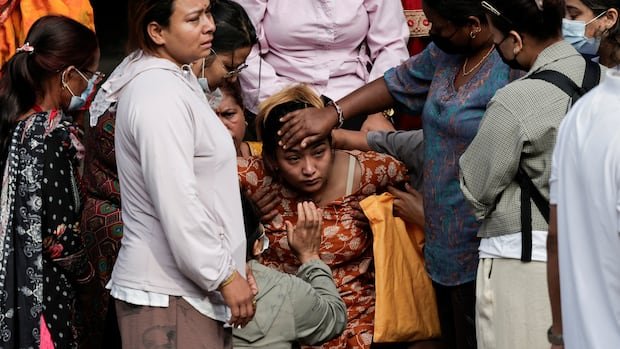

Rescue teams in Nepal’s mountainous region are urgently working to access numerous workers believed to be trapped inside hydropower tunnels, offering a glimmer of hope in the aftermath of a devastating flood that claimed over 1,200 lives last week. Triggered by a glacier collapse near the China-Nepal border, the flood wreaked havoc across towns and valleys, leaving 1,204 confirmed dead and over 4,200 missing.
Focused rescue efforts are now directed at hydroelectric project tunnels where authorities suspect workers might have survived, isolated by floodwaters and debris. Some of these tunnels have air supplies, raising optimism for the approximately 900 missing workers. Amshu Kiran Shahi, a Nepal Electricity Authority board member, expressed confidence in finding survivors due to available food and water in the tunnels.
As the search for survivors continues, particularly in the tunnel complexes, the likelihood of locating survivors elsewhere diminishes. Despite the challenging conditions, rescue operations persist along the border with China, where the floods wreaked havoc. “The hope of finding survivors is decreasing,” remarked Phanindra Paudel, a senior official at Nepal’s National Emergency Operation Center, though efforts persist with unwavering hope.
Prime Minister Balendra Shah affirmed the government’s commitment to ongoing search and rescue operations to find missing individuals and support those affected. Major rescue operations are underway at multiple tunnel sites, with a particular focus on two projects where nearly 100 people are missing, offering better chances of finding survivors due to the presence of air pockets.
International rescue teams from India, China, and the United States are actively involved in the tunnel rescue missions. Meanwhile, across the border in Tibet, China reported an increased toll of at least 21 dead and 541 missing, following the reopening of the road to the Gyirong border crossing. This development enabled heavy machinery to access the core disaster zone for the first time.
In Nepal, efforts are underway to restore power supply, telecommunication services, and transportation links using Bailey bridges. The disaster disrupted 431 megawatts of electricity generation capacity, according to Prime Minister Shah. The restoration efforts, aided by foreign assistance, have already seen 95% of telecom services restored in affected areas by Tuesday.
The catastrophe has left children in Nuwakot and Rasuwa regions traumatized, with many showing signs of distress after witnessing the flood’s devastation. International charity Save the Children highlighted the urgent need for mental health and educational support for these affected minors. Shah acknowledged the disaster’s magnitude and praised the swift action of security personnel in warning residents, despite some personnel being reported missing.