

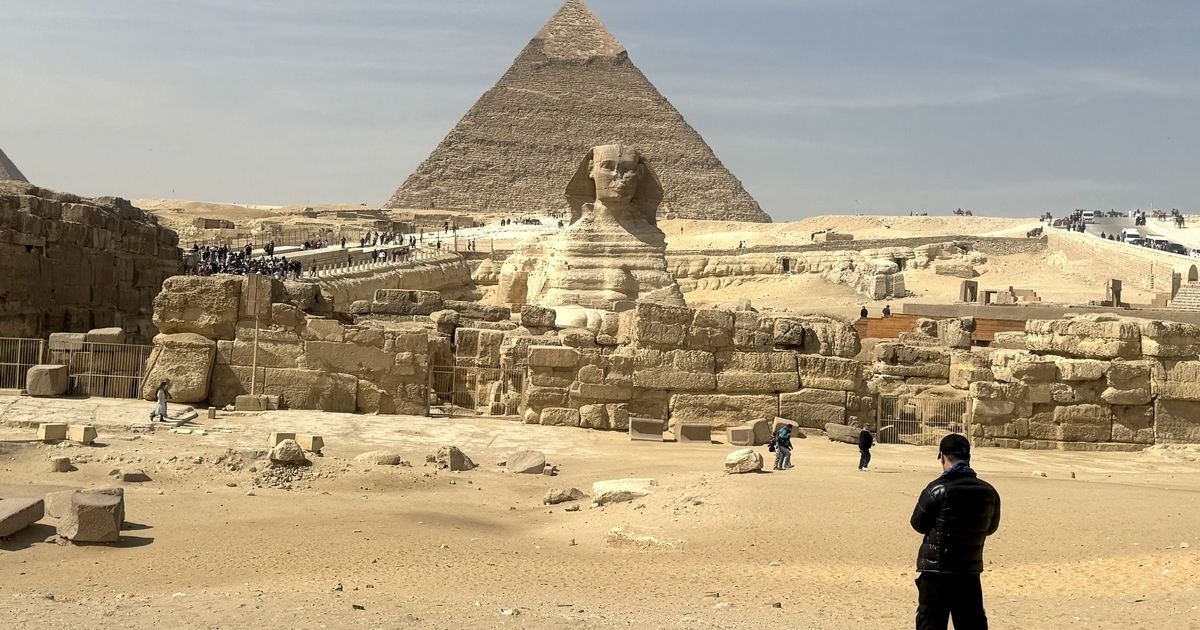

Archaeologists have uncovered enigmatic structures near the Great Pyramid of Giza. A team comprising researchers from Japan and Egypt utilized advanced technology to survey the Western Cemetery at Giza, revealing intriguing anomalies. One of these anomalies is an L-shaped feature located approximately two meters below the surface, with a larger, deeper zone directly beneath it.
The Western Cemetery served as the burial ground for King Khufu’s relatives and high-ranking officials over 4,500 years ago. The newly discovered structures, identified between 2021 and 2023, have been detailed in the journal Archaeological Prospection.
The shallow structure, measuring a minimum of 10 meters in length, appears to have been filled with sand post-construction. Additionally, the deeper anomaly, described as ‘highly resistive,’ suggests the presence of compacted sand and gravel or a void, hinting at the possibility of walls, shafts, or a chamber.
Lead researcher Motoyuki Sato from Tohoku University expressed confidence that the sharp geometry of the anomalies rules out natural formation. While the findings may indicate vertical limestone walls or shafts related to a tomb, further investigation is required for confirmation.
Notably, Harvard Egyptologist Peter Der Manuelian highlighted the significance of the location, emphasizing the unexplored nature of the area within the cemetery. He mentioned that although L-shaped offering chapels are known at Giza, they are typically above ground, making this discovery particularly intriguing and deserving of additional exploration.
Excavations are currently ongoing to verify the scan results and potentially unveil a previously unknown burial site or chamber. The outcome of these excavations could potentially revolutionize the understanding of burial practices for King Khufu’s family and elite individuals on the Giza Plateau.