

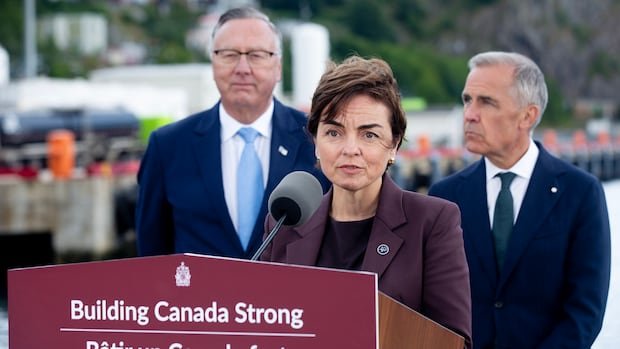

Prime Minister Mark Carney visited St. John’s recently to unveil a groundbreaking agreement concerning Churchill Falls and other power initiatives in Labrador, together with N.L. Premier Tony Wakeham and Quebec Premier Christine Fréchette. This momentous deal, hailed as the most extensive clean energy investment in North America’s history, amounts to nearly $70 billion, with the Canadian government contributing $10 billion in financial backing. The funds are earmarked for enhancing the Churchill Falls power station, constructing the Gull Island hydroelectric project, erecting transmission lines, and launching a 2,000-megawatt onshore wind power project in Labrador.
The upgrades will augment Churchill Falls’ current power production capacity to the extent of supplying enough electricity to illuminate, warm, and cool all residences in Toronto, Montreal, and Vancouver combined. This development holds significant implications for Quebec, Fréchette, and the imminent provincial election campaign.
While the framework announced on Monday is a step forward, it remains provisional until March 2027. A definitive agreement still necessitates signing, with hopes of finalization by year-end. With the provincial election slated for October 5, a change in government before the official deal signing remains a possibility.
Under this new deal, Quebec stands to gain access to over 10,000 megawatts, exceeding a quarter of Hydro-Québec’s current total output. Compared to the rejected 2024 Churchill Falls Memorandum of Understanding, which Wakeham dismissed shortly after taking office, the potential power output surges to 7,200 megawatts. The electricity from Churchill Falls will be sold to Quebec at an average rate of 6.2 cents per kilowatt-hour, potentially resulting in savings of $200 billion over the deal’s duration.
Yvan Cliche, an energy sector expert at Université de Montréal’s Center for International Studies, lauded this agreement as a historic milestone for Quebec. He believes the deal will not only benefit the energy sector but also enable Hydro-Québec to maintain competitive rates.
For Fréchette, this agreement signifies a pre-election victory and an opportunity to showcase her economic acumen. The premier hailed the deal as a strategic partnership securing Quebec’s energy needs for the next five decades while generating numerous job opportunities. If her party retains power post-election, Fréchette vows to ensure the deal’s official implementation.
The impending Quebec election campaign, set to kick off shortly, has placed Fréchette under scrutiny, drawing criticism from opposition parties. Parti Québécois Leader Paul St-Pierre Plamondon, in a recent social media post, questioned Fréchette’s authority to commit Quebec to a 50-year deal just before the campaign. Tensions escalated with verbal exchanges between the two leaders during a news conference.
Various parties have voiced concerns regarding the timing and terms of the agreement. Quebec Conservative leader Éric Duhaime accused Fréchette of diverting attention from alleged financial mismanagement under the current administration. Ruba Ghazal from Québec Solidaire criticized the deal for serving political interests rather than the public good. The Quebec Liberal Party’s Charles Milliard acknowledged the agreement’s merits but underscored the necessity for a thorough analysis before formal approval.
Fréchette challenged opposition parties to present alternative proposals, emphasizing the benefits the agreement brings in terms of job creation and energy supply. She defended the deal’s significance in generating economic growth and employment opportunities for Newfoundland and Quebec.