

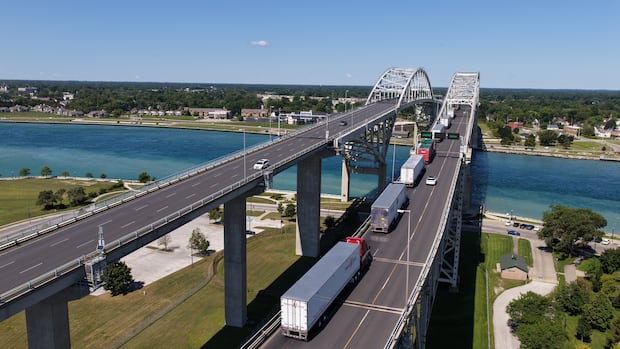

On Monday, communities along the Canada-U.S. border prepared for further economic repercussions after the collapse of trade negotiations, leading both nations to intensify their tariff conflict.
Sarnia’s Mayor Mike Bradley, representing a significant Ontario border city and petrochemical center, expressed concerns that the ongoing trade dispute would serve as a “job killer” for the local economy. The city is a prominent exporter of plastics, which are among the goods affected by the latest U.S. tariffs.
While he supported the federal government’s actions, he cautioned that the initial solidarity in his community might wane once the severe impacts of the tariff conflict become apparent.
“At this point, everyone can show their support. However, as job losses and industry hardships begin to materialize, I believe it will become increasingly challenging to maintain public unity in Canada,” he remarked, urging fellow leaders to remain united.
Prime Minister Mark Carney has pledged a one-to-one response to the 50 percent tariffs that the U.S. has placed on around $28 billion worth of Canadian products following the failed negotiations. Canada’s counter-tariffs are scheduled to take effect on September 8, targeting industries such as steel, dairy, pulp and paper, electronics, and appliances.
Tensions heightened once more on Monday as U.S. President Donald Trump threatened to impose 50 percent tariffs on Canadian automobiles and auto parts starting January 1. His warning also included steel, which is already facing a 50 percent tariff.
These new threats sparked worry in Windsor, the center of Canada’s automotive industry. Mayor Drew Dilkens stated that such tariffs would result in job losses if they were enacted, but he expressed hope that “sensible minds will prevail” in the meantime.
Dilkens highlighted the upcoming U.S. midterm elections as an opportunity to draw attention to the potential repercussions of the tariff conflict in pivotal states like Michigan.
“This conflict initiated by Donald Trump against Canada, its largest trading partner, will ultimately prove to be significantly detrimental to the United States, yet there will be casualties if this persists,” Dilkens remarked.
Several Democratic governors from U.S. border states voiced their objections to Washington’s actions over the past weekend.
Michigan Governor Gretchen Whitmer noted that residents in her border state were “uniquely affected” by the trade dispute, contending that tariffs inflate costs for families and businesses while jeopardizing the auto industry.
New York Governor Kathy Hochul criticized the president for “unnecessarily instigating conflicts” with American allies.