

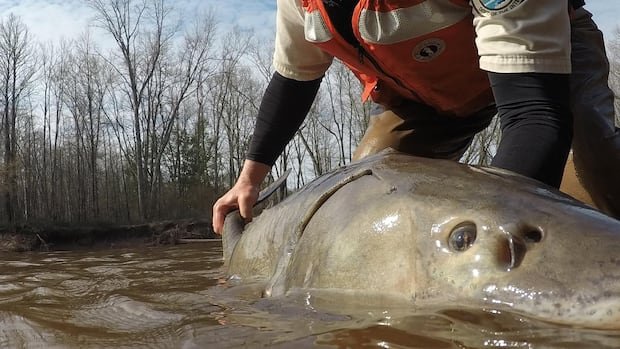

A recent study indicates that some of the lake sturgeon inhabiting the Great Lakes today may have been alive during Samuel de Champlain’s arrival at Lake Huron over 400 years ago. These ancient-looking, armored fish are believed to have a longer lifespan than previously assumed, potentially exceeding 400 years.
Despite their remarkable longevity, lake sturgeon, which can reach weights of up to 180 kilograms and lengths of two meters, are facing endangerment. In Ontario, lake sturgeon are categorized as a species at risk, with populations in the Great Lakes region being particularly threatened.
Historically, overfishing and habitat destruction have led to a drastic decline in lake sturgeon populations, with an estimated 99% reduction in their numbers. Even today, efforts are being made to support their recovery, including human intervention in raising and releasing young sturgeon.
The study, led by Ed Baker, a fisheries scientist from the Michigan Department of Natural Resources, analyzed over four decades of data on captured and recaptured lake sturgeon across the Great Lakes. The findings suggest that the road to recovery for these fish may be longer than initially anticipated.
Traditional methods of estimating sturgeon age by counting growth rings have limitations as sturgeon growth slows with age, making ring counting less reliable. Instead, Baker and his team used capture data to calculate individual sturgeon growth rates over time to estimate their potential lifespan accurately.
The new longevity estimates have implications for conservation efforts. Trevor Pitcher, a biologist at the University of Windsor, emphasized the need to reassess conservation strategies for a species that can potentially live for centuries. The current century-long conservation plan in Canada may need adjustments to align with the extended lifespan of lake sturgeon.
Pitcher also highlighted the ecological importance of sturgeon in controlling invasive species like quagga mussels and gobies. Their decline due to human activities has disrupted the natural balance in the ecosystem, underscoring the urgency of conservation efforts.
For Perry McLeod-Shabogesic, an elder from Nipissing First Nation, lake sturgeon hold significant cultural and spiritual value. In Anishinaabe tradition, these fish are revered as elders due to their longevity and role in passing knowledge across generations.
The unique characteristics of sturgeon, as described by McLeod-Shabogesic, symbolize their intermediate status between different realms, reflecting a deeper spiritual connection. An ancient Nipissing story further underscores the mystical nature of sturgeon and their significance in bridging worlds.
The acknowledgment of sturgeon’s potential multi-century lifespan by scientists aligns with indigenous knowledge and traditions, validating the deep-rooted understanding of these remarkable creatures.