

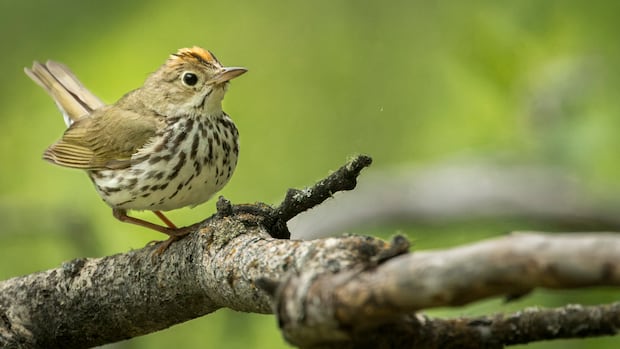

From tweets to melodies, the songs of birds can resemble a grand orchestra.
However, the ovenbird — a stout, ground-nesting warbler — has a very limited selection of songs.
The male ovenbird produces only one song, which is a quick tune often referred to as teacher-teacher-teacher.
While to many listeners, all ovenbirds appear identical in their singing, each one has its own unique rendition.
Recently, scientists have begun utilizing artificial intelligence to monitor the health of ovenbird populations based solely on their distinct songs.
A study published this month in the journal Nature Methods employed AI technology to identify individual ovenbirds in audio recordings obtained from Alberta and Pennsylvania.
Single-song focus
The ovenbird’s “specific” song selection made it an excellent candidate for research, noted lead researcher Sam Lapp, a postdoctoral scholar at the University of Colorado.
“They are quite consistent in singing one very particular song,” Lapp explained in a conversation with CBC News.
“Many birds develop a vocal signature over their lifetime, often including various songs in what we define as their repertoire.
“However, the ovenbird uniquely maintains one stable song throughout its life, only delivering one version of it.”
Ovenbirds perform their primary song during the spring to mark their territory and attract partners, maintaining this constant melody throughout their lives.
Under Lapp’s guidance during his tenure with the Department of Biological Sciences at the University of Pittsburgh, the research team analyzed recordings collected from approximately 130 locations in Pennsylvania over a span of four years.
They trained an AI model to identify distinctive features of the songs and group similar songs together, presuming that each bird would return to the same forest area each spring.
The team processed 9,072 hours of audio to track 405 individual birds, subsequently testing the model with another set of recordings made in the mixed wood and boreal forests of Alberta during the spring breeding season of 2016.
Lapp reported that the model could associate songs with individual birds with an accuracy of up to 96 percent.
This approach is far less labor-intensive compared to leg banding, a method where biologists capture birds, carefully attach markers to their ankles, and aim to recapture them the following spring.
Lapp mentioned that the idea for this research originated from a collaboration with Alberta biologists looking to locate birds across vast areas using a network of microphones.
“Quite remarkable”
According to Lapp, humans cannot differentiate individual ovenbirds in real time due to the rapid nature of their vocal variations.
However, through spectrographs — visual representations of sound — the unique song of each bird becomes clearer, he stated.
“I began to wonder, if my eyes can detect these patterns, can we train a machine to recognize them and automate the process of identifying individuals?”
“Even for those who are passionate about birds and keen on identifying species, it is astonishing and thrilling to realize such depth of information exists that we’ve overlooked … yet is present if one listens closely enough.”
Erin Bayne, a biology professor at the University of Alberta and a co-author of the study, has been closely observing ovenbirds for years and understands the challenges of annual population monitoring.
Throughout his PhD, Bayne dedicated countless hours tracking banded birds, enabling him to distinguish individuals based on their unique vocal traits.
“What that one is saying over there is slightly different from what that one is saying over here,” he explained. “I could recognize who was who.
“They exhibit remarkable politeness when singing. It’s quite amusing, actually. One bird will sing, then the other will wait for him to finish before immediately starting its own song.”
Birds communicate with each other
Bayne stated that the research indicates avian communication is far more intricate than most people realize, with conversations occurring even if we fail to grasp the language.
Just as humans have unique speech patterns, biologists are discovering that certain animals also develop their own distinct voices, Bayne noted.
“It’s not surprising in many respects that individual birds or other animals possess detectable differences. The more we examine this, the clearer it will become.”
Though the model has its limitations, the researchers anticipate that it will offer a less intrusive method for assessing the health of songbird populations through mere listening.
The AI system currently cannot accurately track the diverse calls of female ovenbirds or the basic sounds produced by juveniles.
Additionally, the existing program would not be effective for species like magpies and mockingbirds that constantly imitate new sounds or sing a wide variety of songs.
It is best suited for birds that sing one consistent song throughout their lives — which represents around 30 percent of songbird species — as well as certain bat and owl species.
The researchers have made the program code available on open-source platforms to assist other biologists in tracking the survival of different songbird populations or even other species.
Richard Hedley, a statistical ecologist at the Alberta Biodiversity Monitoring Institute who was not involved in the study, remarked on its significant potential.
While AI acoustic monitoring has been utilized for years to track birds at the species level, demonstrating the ability to differentiate individual birds is an impressive accomplishment, he stated.
There exists a wealth of acoustic recordings that could be utilized in innovative ways, he added.
“It can take many hours just to capture a single bird. Therefore, the prospect of achieving this by simply placing a microphone in the bird’s territory is extremely promising.”