

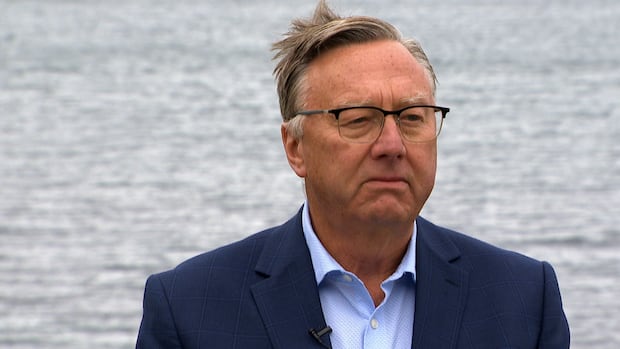

Premier Tony Wakeham of Newfoundland and Labrador is currently in Norway for the Offshore Northern Seas oil and gas conference, but his focus remains on addressing the provincial implications of the ongoing trade conflict between Canada and the U.S.
In a statement released on Tuesday afternoon, Wakeham acknowledged that tariffs would lead to increased expenses for both businesses and consumers, disrupt supply chains, and generate uncertainty in Newfoundland and Labrador. Although the province may experience relatively less direct impact, it is not exempt from the effects.
As Canada implements its own retaliatory tariffs on a dollar-for-dollar basis in response to U.S. trade measures, Wakeham praised Prime Minister Mark Carney for his leadership, affirming that the provincial government remains fully supportive.
“During these uncertain times, Newfoundland and Labrador will consistently align with Team Canada to safeguard our economic interests and promote a stable and constructive trading relationship with our nearest neighbor and largest trading partner,” the statement indicated.
Regarding provincial matters, Wakeham mentioned he has engaged with “our key industry partners that contribute to the Newfoundland and Labrador economy,” and they will be monitoring the effects of trade policies closely together.
When CBC inquired about his contacts, a member of his communications team mentioned that the outreach has involved organizations such as Mining Industry N.L. and the Newfoundland and Labrador Federation of Labour, although this was not an exhaustive list.
The Government of Canada has rolled out counter tariffs targeting $27.6 billion worth of U.S. goods, effective as of September 8. Concurrently, it has pledged $7.5 billion in support for workers and businesses.
In terms of response initiatives, the premier emphasized the need for them to be both ambitious and focused, stating, “We will thoroughly evaluate the measures to guarantee Newfoundland and Labrador receives the necessary support to safeguard jobs and communities.”
Request for Roundtable
At the same time, opposition leaders in Newfoundland and Labrador are urging the ruling Progressive Conservatives to reinstate a previously active “premier’s roundtable” on tariffs. This roundtable was established under former premier Andrew Furey and included representatives from unions, businesses, and other stakeholders.
“Our response cannot solely originate from the premier’s office – it should involve meaningful engagement with those who are acutely aware of how this trade conflict is affecting us locally,” stated NDP Leader Jim Dinn.
Dinn remarked that Canada is “rightly moving away from an unfavorable agreement” with the U.S., making it crucial to revive the roundtable while addressing the ongoing repercussions.
Previously, the NDP advocated for non-profit representatives to be included in discussions, a request that has been reiterated this week.
“I think of organizations like Connections for Seniors or Choices for Youth—these groups, along with many others, directly assist those most in need within our province. With many individuals already feeling financial pressure from the cost of living, it’s essential to involve these organizations in the dialogue to ensure no one is overlooked,” he stated.
The provincial Liberals have called on Wakeham to “step into the light” and revive the roundtable discussions.
“Regrettably, we have not heard from Premier Wakeham on this critical matter or witnessed the proactive leadership necessary during this situation,” Liberal Leader John Hogan commented. “Industries and workers in our province need assurance that their government is attentive, ready to support them, and taking the required measures to shield them from any adverse effects stemming from this ongoing trade conflict.”
Concerns from Small Business Owners
Jonathan Galgay, the director of legislative affairs at the Canadian Federation for Independent Business, noted that despite calls for more engagement from the premier, Wakeham had already contacted organizations, including CFIB, the previous Monday.
“We did not participate in that former roundtable,” Galgay mentioned, adding that he appreciated the email correspondence from the premier. He provided additional insights regarding his members’ concerns to the government on Tuesday.
For the CFIB, Galgay indicated that an early concern revolves around federal response programs, emphasizing the importance of ensuring criteria for accessing key programs are conducive to smaller, independent businesses. He expressed apprehension regarding minimum sales requirements for the Regional Tariff Response Initiative.
According to the Atlantic Canada Opportunities Agency, despite certain requirements, 32 organizations successfully accessed a prior version of the regional response program following an earlier round of tariffs. ACOA reported that “over $12 million” in total assistance has already been allocated to Newfoundland and Labrador, with details for the new round of the program still in the works.
Galgay remarked that there are numerous factors to consider, as the new tariffs and countermeasures have only recently been announced.
“Regardless of your affiliation, it’s crucial to take time to comprehend the ramifications,” he advised, adding that he appreciates the provincial government’s efforts in “conducting their due diligence” as well.
In a statement, the premier’s office mentioned that Wakeham has been reaching out via email to partners, seeking early indications of impacts, and is eager to engage with stakeholders.
Download our free CBC News app to sign up for push alerts for CBC Newfoundland and Labrador. Sign up for our daily headlines newsletter here. Click here to visit our landing page.