

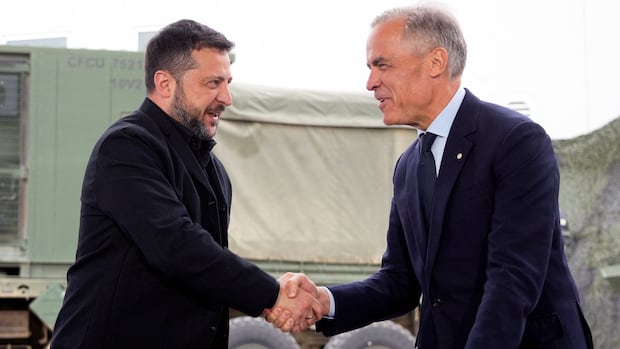

On Thursday, Canada and Ukraine strengthened their bond by signing a long-lasting strategic and political partnership aimed at establishing a framework for the production of millions of drones to bolster the defense of both nations.
The two countries formalized a declaration to create a century-long partnership encompassing various areas, including defense and security, trade and investment, as well as energy and critical minerals. The specific implementation details of this long-term agreement will be developed in the upcoming months.
The partnership was initiated with several contracts focused on drone manufacturing and investments in the defense sector.
Prime Minister Mark Carney commented that the situation in Ukraine has reached a pivotal moment, with some of its uncrewed systems now operating hundreds of kilometers deep within Russia.
He also recognized the significant impact of Russia’s intensified missile and drone attacks on Ukraine, particularly in Kyiv, which has been subjected to ceaseless bombardment.
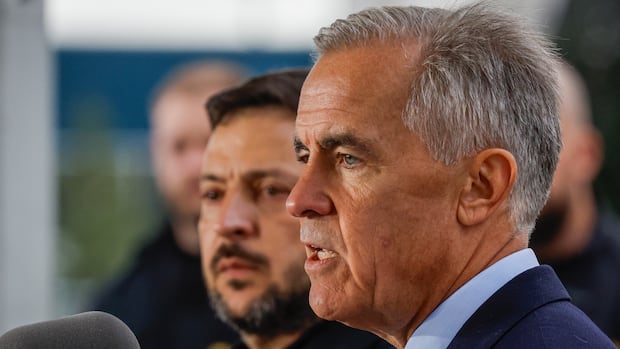
In a discussion with Ukrainian President Volodymyr Zelenskyy on Thursday, Prime Minister Mark Carney mentioned that a ceasefire between Russia and Ukraine could serve as a potential ‘short-term solution’ to global challenges regarding energy access and agricultural products.
“Canada will always stand united with Ukraine,” Carney stated alongside Ukrainian President Volodymyr Zelenskyy in Calgary.
“Canadians fundamentally understand the significance of your fight. Our commitment is unwavering. Your battle for freedom, democracy, and sovereignty is our own.”
Drawing inspiration from Ukraine’s wartime experiences, Canada is set to establish its own drone marketplace where military units can directly engage with companies to swiftly meet their requirements.
“This initiative is a crucial element of our strategy to build industrial capacity for producing millions of drones within the next two years,” Carney stated.
Currently, the Canadian military possesses only 2,000 drones of various types in its inventory.
-
Canada commits nearly $1B to drone and airborne defence research
-
Canadian Armed Forces holds drone testing event with manufacturers in Ottawa Valley
Canada has awarded contracts valued up to $50 million, which will expand the number of drones currently operated by the Canadian Armed Forces by tenfold. This first phase aims to acquire intelligence, surveillance, reconnaissance drones, and uncrewed ground vehicles (UGVs), involving six companies from New Brunswick, Quebec, Ontario, and Saskatchewan.
The governments also intend to collaborate with Canadian and Ukrainian firms to manufacture drones.
“Consequently, Canadian industry will gain insights from the most battle-tested developers in the world,” Carney remarked.
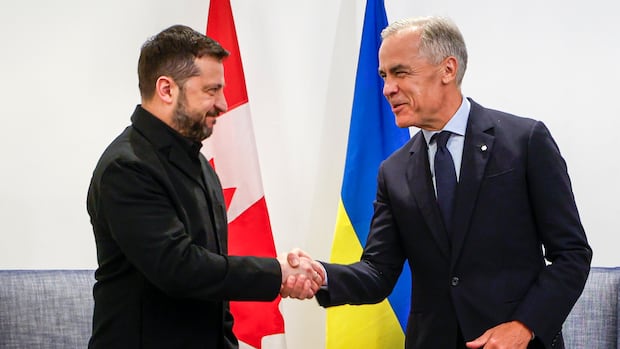
Prime Minister Mark Carney and Ukrainian President Volodymyr Zelenskyy signed a 100-year strategic and political partnership aligning the two countries on everything from defence and energy to critical minerals. The agreement also includes plans to build millions of drones.
It was announced on Thursday that General Dynamics Mission Systems-Canada will join forces with the Ukrainian company Green Tech Harvest to develop and manufacture drones and related technologies. This collaboration builds upon a previous partnership established in May between Airlogix LLC and Sentinel Research & Development.
Furthermore, Canada and Ukraine are establishing a long-term alliance to co-produce uncrewed systems, counter-drone technologies, munitions, and artificial intelligence solutions.
-
Ukrainian President Volodymyr Zelenskyy arrives in Canada
-
Canada ready to further distance itself from U.S. on military procurement
-
Analysis
No longer taboo, Canada’s defence industry steps into Europe’s spotlight
Zelenskyy described the agreement as a “very important package” capable of impacting the lives of Ukrainians.
“I’m delighted to be here among friends,” the Ukrainian president expressed before the agreement signing. “Thank you for your support, for standing with Ukraine, Ukrainians, our children, and our sovereignty.”
Zelenskyy mentioned that Carney has been advocating for a quicker timeline for the co-production agreement.
“We initiated the first step and our teams indicated that we could finalize the drone deal in 90 days,” the Ukrainian leader stated. “Then Mark proposed, can we expedite it to nine days? And the teams promptly responded, ‘Yes, absolutely.’
Additionally, Zelenskyy hinted at Carney’s announcement that Canada was prepared to join FREYA, a pan-European anti-ballistic missile defense initiative spearheaded by the Ukrainian defense company Fire Point. The aim is to create a more affordable alternative to American Patriot missile systems, which are currently in limited supply.
One of the hurdles Canada faces in the race to catch up with Ukraine is the rapid evolution of drone technology. On the battlefield, certain types of uncrewed equipment can become outdated within three to six months. At the front lines, tactics—the methods by which drones are utilized—can shift in a matter of four to six weeks as both sides adapt.
This is something the Canadian military monitors closely when determining how many drones to maintain in reserve.
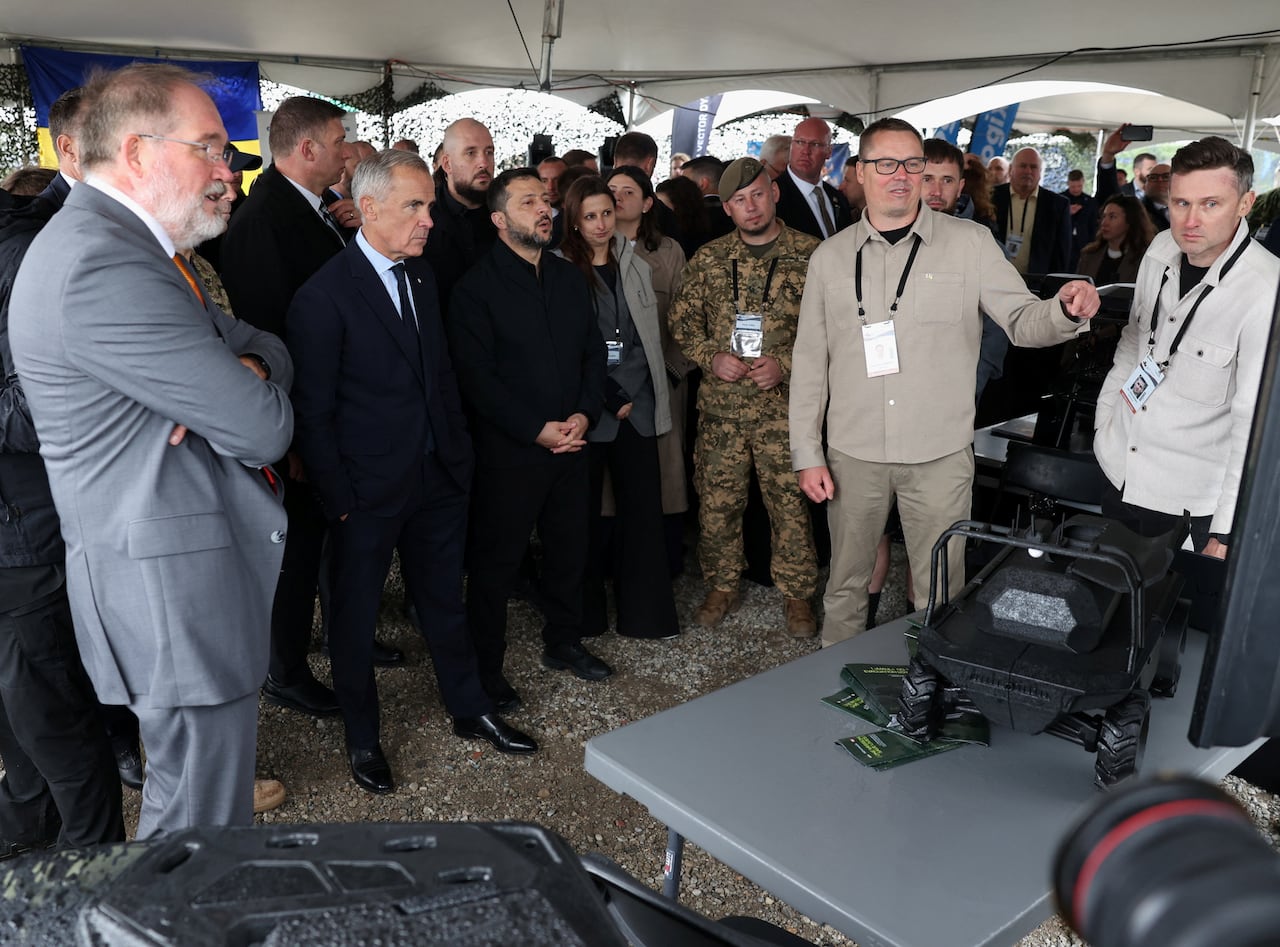
Carney and Zelenskyy observe drones during a visit to the Southern Alberta Institute of Technology in Calgary. (Ahmed Zakot/Pool/Reuters)
“However, that doesn’t imply we need to amass millions of drones on our shelves, as all stakeholders in this field recognize that technology is advancing at a rapid pace,” stated Lt.-Gen. Darcy Molstad, Commander of Canadian Joint Forces Command, in an interview with CBC News.
“If we were to stockpile two million drones, within one or two or six months, they could all become outdated due to the swift technological advancements. Nevertheless, we must establish an industrial base capable of producing at that volume and scaling up when necessary.”
According to Molstad, Ukraine is at the forefront of drone technology and its application.
“We have many operational lessons to learn from them,” he noted. “That said, we possess all the necessary components here in Canada; it’s simply a matter of coordinating everything together.”
Carney also unveiled a series of investments aimed at enhancing Ukraine’s defense and long-term security. This includes $350 million allocated for critical air defense interceptors, which will be acquired through the United States’ Joint Ukraine Multinational Program – Services, Training and Articles Rapid Timeline (JUMPSTART).
As Ukraine braces for another winter, Carney highlighted that ongoing Russian attacks on energy infrastructure jeopardize vital services in the country. Canada plans to provide nearly $435 million in new loan guarantees to the European Bank for Reconstruction and Development to support energy security, particularly for winter gas purchases. An additional $200 million in concessional loans is also slated through Export Development Canada to aid in Ukraine’s reconstruction efforts.
Moreover, Canada will contribute up to $40.1 million for rehabilitation programs aimed at Ukrainian veterans and their families.