

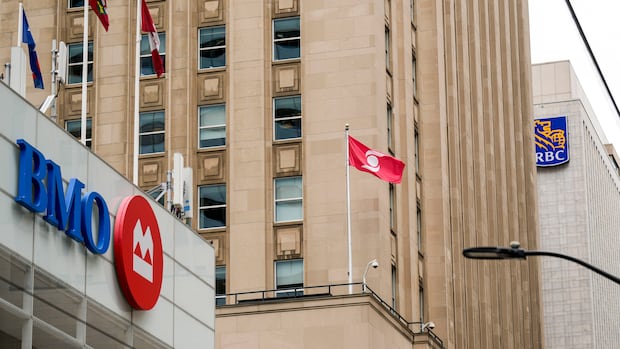

Although Canada’s major banks are shielded from direct tariff impacts, their extensive collections of consumer and business loans, totaling trillions of dollars, are vulnerable to the economic repercussions stemming from the intensifying trade conflict with the United States.
Nevertheless, leading executives appear to be unfazed.
This week, Canada’s largest financial institutions began sharing their third-quarter financial results. Their most recent earnings come amid a climate of political posturing, with Canadian officials implementing financial support to mitigate the effects of U.S. tariffs.
Bank of Montreal and Scotiabank were the first to release their results on Tuesday, followed by National Bank on Wednesday. Royal Bank of Canada, Toronto-Dominion Bank, and CIBC are set to report their figures on Thursday.
During a conference call with stock market analysts after the earnings announcements, National Bank’s president and CEO Laurent Ferreira stated that Canada’s economy has shown “resilience” over the past 18 months amidst increased uncertainty with its primary trading partner. He commended the recent aid initiatives from the government aimed at supporting workers and businesses.
“The announcement made yesterday regarding support for businesses and workers is appreciated and should alleviate pressures for those affected,” Ferreira remarked on Wednesday. “Continuous discussions with our clients and partners lead to a single conclusion: Canada is making the right moves to solidify its economic foundations, with the fiscal capability to keep progressing.”
On Tuesday, Scotiabank’s CEO Scott Thomson described the recent trade fluctuations as “manageable,” while highlighting some positive aspects of Canada’s economy.
“The underlying fundamentals in Canada are quite solid,” Thomson noted during Scotiabank’s conference call. “When examining job growth statistics, fiscal capacity supported by oil prices, and the activities emerging from the Prime Minister’s agenda, the backdrop appears quite positive.”
Recently, U.S. President Donald Trump imposed a 50 percent tariff on around $28 billion worth of Canadian goods. According to Scotiabank, these new tariffs directly affect less than one percent of the bank’s overall loan portfolio.
However, banks remain significantly exposed to widespread macroeconomic downturns through various consumer products, including mortgages, car loans, and credit cards, among others.
Major banks find opportunities amid trade tensions
“This certainly introduces uncertainty, but the current tariffs are manageable,” Thomson stated.
“As a nation, we should harness this moment to further accelerate the Prime Minister’s agenda, dismantling interprovincial trade barriers, speeding up approval processes, accomplishing significant projects, and continuing to diversify our trade while maintaining our strong trading relationship with the U.S.”
Bank of Montreal’s CEO Darryl White supported Thomson’s perspective during BMO’s conference call.
“I believe it is entirely manageable,” he expressed on Tuesday. “We need to recognize that any impact this might have stands a very high chance of being alleviated in various ways.”
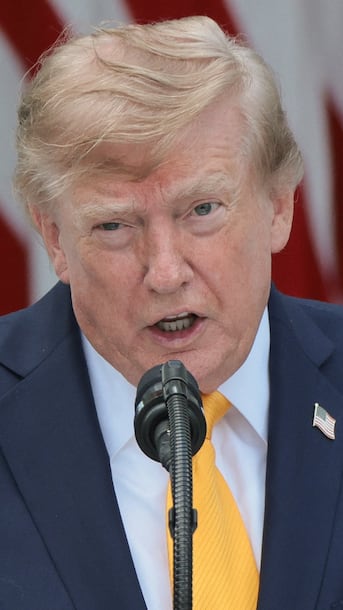
U.S. President Donald Trump is imposing new 50 per cent tariffs on dozens of Canadian goods under section 338 of the U.S. Tariff Act. Some of these targeted items correspond with the dairy and alcohol grievances the U.S. is raising, but a swath of tariffed goods, mostly listed under the auto grievance, are seemingly unrelated.
Similar to Thomson, White positioned the ongoing Canada-U.S. tensions as a chance for both federal and provincial governments to eliminate internal trade obstacles.
BMO has a substantial presence in the U.S., having invested $16.3 billion to expand its operations south of the border through the acquisition of Bank of the West, marking its largest acquisition to date. White has estimated that currently, 40 percent of BMO’s assets are allocated to the U.S. market.
Last year, he remarked that Trump’s “America First” policy could ultimately benefit Canada’s economy.
“It may be America first, but it doesn’t mean America is alone,” White stated to a business gathering at the 2025 Toronto Global Forum. “If Canada is second in an America-first context, and there is a multitude of nations behind you, this idea of advantage for North America becomes increasingly tangible.”
On Wednesday, Ferreira from National Bank expressed optimism that the recently announced investment initiatives by the federal government would create lending prospects for his institution.
“Projects in energy, power infrastructure, and the recent icebreaker contract announcement exemplify our country moving in a positive direction,” he noted.
“Investments in these areas are essential for enhancing Canada’s productive capacity and fostering sustainable economic growth across the nation. The restructuring of the Canadian economy is generating appealing opportunities to utilize our balance sheet.”
The stock of Canada’s largest banks is currently trading close to record highs on the Toronto Stock Exchange.
John Zechner, chairman of the investment management firm J Zechner Associates based in Toronto, mentioned that both Scotiabank and BMO reported lower-than-anticipated loan loss provisions in their latest quarters, which are funds that banks reserve for defaults or unpaid loans.
“Up until now, the economy in Canada has shown considerable resilience,” Zechner stated to CBC News, while noting that conditions are expected to “get tougher.”
“The Canadian banks … will inevitably feel the effects of this situation.”