

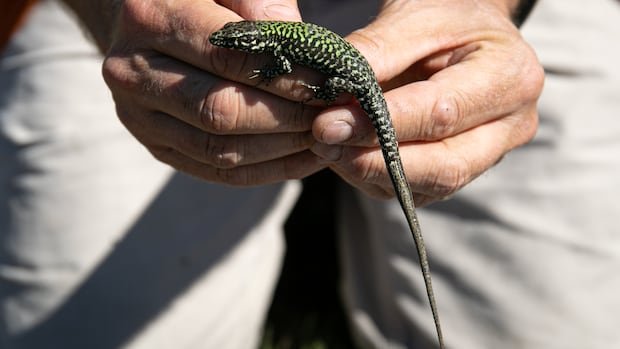

Tracy Menzies had been in a constant battle with slugs in her backyard garden, struggling to harvest before they did. However, this year, her strawberries thrived beautifully. The reason behind the slugs’ decline seems to be the increasing presence of European wall lizards in the area, known for rapidly spreading and devouring various creatures, including slugs.
Living near the Gorge Waterway in Saanich, Menzies observed a surge in the number of wall lizards in her yard, darting around the garden. She believes these lizards are now preying on the slugs, as she hasn’t spotted any in her yard since the lizards appeared.
Gavin Hanke, a curator at the Royal B.C. Museum, estimated the population of European wall lizards in British Columbia to be between 800,000 to a million, primarily concentrated on Vancouver Island and extending up to Campbell River, 220 kilometers north of Victoria. He expressed concerns about the environmental impact of their rapid spread.
Notably, these lizards, mostly a few inches in size, have been flourishing across the region, including in areas like North Saanich, where they have grown up to eight to 10 inches. Menzies, a real estate agent, highlighted their increasing presence in both urban and rural settings.
Biologist Nicholas Wong from the Invasive Species Council of B.C. emphasized the lack of official programs to manage the lizard population growth. He mentioned the competition these lizards pose to native species for resources and habitat.
The invasion of European wall lizards in B.C. originated from a deliberate release of a dozen lizards in 1970 after the closure of a roadside zoo in Central Saanich. Their adaptation to the climate of Southern Vancouver Island has fueled their proliferation, with the Invasive Species Council of B.C. noting their annual spread rate and potential transmission through various means.
Despite aiding in controlling pests like slugs, concerns about the unchecked expansion of the lizard population persist among residents. Suggestions to mitigate their spread include maintaining unattractive habitats for the lizards and fostering collective efforts within communities to prevent re-infestation.
Hanke acknowledged the inability to eradicate the lizards at this stage, underlining human responsibility for introducing and fostering their growth in the region. He cautioned against relocating the lizards, as it could exacerbate their spread to new territories.
In conclusion, the presence of European wall lizards on Vancouver Island poses ecological challenges, emphasizing the need for proactive measures to address their impact and prevent further proliferation beyond the region.