

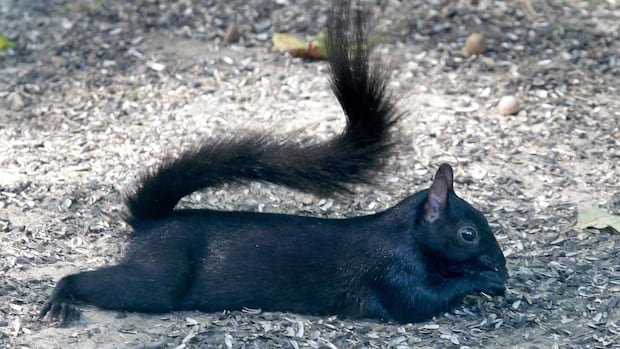

Francis Quang-Hai Dinh spent his first summer at McGill University exploring Montreal-area parks on his bicycle, on a quest to observe squirrels. He meticulously documented over 800 grey and black squirrels in nearly 200 green spaces spanning from Mirabel to Saint-Bruno. What began as a simple undergraduate task evolved into a passion project aimed at unraveling the impact of the city’s layout and meandering waterways on evolution.
Dinh, who is now pursuing integrative biology at the University of Illinois Urbana-Champaign, became the sole researcher to conduct manual squirrel surveys park-by-park across the region due to a lack of car access and limited public transportation options in suburban areas.
His research revealed that approximately 12% of squirrels in Montreal are black, with the percentage of black squirrels increasing as he traveled further north. In regions just north of Laval, up to 40% of squirrels had black coats, while on the island of Laval, about 20% were black. The percentage dropped to around 15% on the island of Montreal, and just 2-3% on the south shore of Montreal. The study identified temperature as the primary factor influencing these variations, as black squirrels can better absorb heat compared to grey squirrels.
The study’s lead author, Allison Roth, an assistant professor at the University of Missouri and former McGill postdoctoral fellow, emphasized that the research focuses on using squirrels as a model to examine how urban environments drive evolutionary changes. Cities like Montreal, with diverse neighborhoods, varying tree cover levels, and distinct boundaries such as waterways, create nuanced environmental conditions that can lead to genetic and physical adaptations within animal populations.
The study, titled “Fine-scale spatial variation in eastern grey squirrel melanism across a complex urban landscape,” is available online. Contrary to previous studies comparing urban and rural wildlife changes broadly, this research delves into neighborhood-specific transformations. It challenges the notion that human development alone propels these changes, highlighting urban sprawl’s impact on local temperature and tree cover reduction, while natural barriers like riverways also play a significant role.
The findings of the study, part of a special feature by five ecology journals, underscore the indirect influence of urbanization on melanism through environmental factors like vegetation structure and winter microclimate. Dinh expressed a newfound perspective on wildlife, emphasizing the coexistence of urban settings and natural habitats. He noted that wildlife persists despite human modifications, blurring the lines between city and nature.