

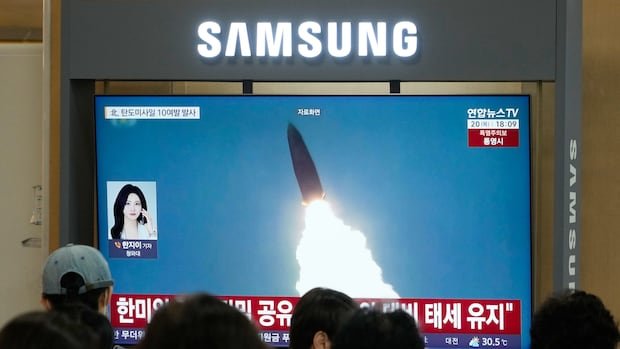

South Korea’s presidential office has strongly condemned North Korea’s firing of over 10 short-range ballistic missiles on Thursday. The office has instructed its military to remain on high alert during the ongoing joint exercises with the United States. An emergency security meeting was held by the presidential office, with officials from the Defense Ministry and military authorities in attendance. The missiles were launched from the Pyongyang area towards the east of the Korean Peninsula, a statement from the office confirmed.
Labeling the missile launch as a serious violation of UN Security Council resolutions, South Korea called on North Korea to immediately cease such provocative actions. The country’s response posture was reviewed by officials, who assessed the security implications of the missile launches and discussed necessary measures, as stated by the office. South Korea’s Joint Chiefs of Staff reported that the missiles traveled approximately 300 kilometers towards the sea.
The missile launch took place a day after South Korea and the U.S. announced a reduction in their 11-day Ulchi Freedom Shield exercises, originally set to conclude by Friday. This decision came following President Donald Trump’s directive to “substantially reduce” the exercise just before it commenced on Monday. Trump cited his positive relationship with North Korean Leader Kim Jong Un and South Korea’s non-support in U.S. actions in Iran as reasons for the reduction.
In response to questions from reporters, Trump confirmed his intention to meet with Kim later this year. He also mentioned that North Korea possesses 57 nuclear weapons, a figure he has not previously disclosed. South Korean officials estimate the number of North Korea’s nuclear warheads to be between 80 and 120.
Kim Yo Jong, the spokesperson for the North Korean regime and Kim Jong Un’s sister, dismissed Trump’s gesture, emphasizing that the reduced military drills still maintain their aggressive nature. She criticized the U.S. and South Korea for previous military exercises and South Korea’s plans to introduce nuclear-powered submarines. Kim Yo Jong affirmed the excellent personal relations between her brother and Trump but refuted Trump’s claim of a response from Kim regarding a conversation request.
Analysts suggest that the missile launch aimed to emphasize Kim Yo Jong’s previous warning and to signal opposition to the South Korea-U.S. military exercises. The launch may also serve as a warning against speculation on North Korea’s security matters and could be a test of improved missile systems.
Trump’s reactions to North Korean missile tests have evolved over time, from threats of “fire and fury” in 2017 to subsequent meetings with Kim. The cost of maintaining U.S. troops in South Korea, estimated at 28,500, has been a recurring concern for Trump, despite a cost-sharing agreement with Seoul until 2030. Trump argues that South Korea’s contribution is insufficient.
Japan also reported North Korea firing a ballistic missile towards the sea, outside Japan’s exclusive economic zone. Chinese Foreign Minister Wang Yi, visiting Seoul, urged South Korea to remain neutral between Beijing and Washington. He called for the U.S. to abandon its “hostile” North Korea policy and expressed China’s support for peaceful coexistence on the Korean Peninsula. Relations between China and North Korea have strengthened, marked by recent meetings between Kim and Xi Jinping.