

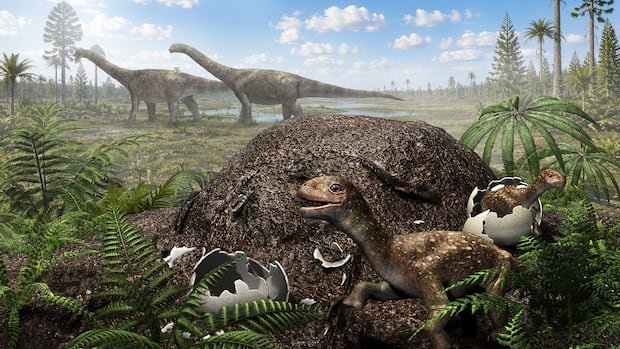

Fossilized eggshells from some of the largest dinosaurs ever discovered have been unearthed in a surprisingly cool environment located far away from the equator. Despite their immense size, these titanosaurs could not rely on brooding to keep their volleyball-sized eggs warm.
A recent study, led by University of Tsukuba paleontologist Kohei Tanaka and published in Royal Society Open Science, examined the microscopic features of the eggshells. The researchers propose that titanosaurs employed a similar incubation method as modern crocodiles by burying their eggs in warm mounds of decomposing vegetation.
Titanosaurs were colossal, herbivorous dinosaurs characterized by their long necks and tails, quadrupedal stance, and weight of up to 75 tonnes, comparable to half the mass of a blue whale. Fossilized eggs known as Fusioolithus have been associated with titanosaurs and were previously discovered in warmer regions.
In 2020 and 2024, fragments of Fusioolithus eggshells were found in the Late Cretaceous Chorrillo Formation in southern Argentina. Despite the shift in the formation’s latitude over time, it was once situated as far from the equator as Red Deer, Alta., with a climate akin to present-day New York City.
The Chorrillo Formation housed a diverse ecosystem teeming with dinosaur species like the titanosaur Nullotitan glaciaris, measuring up to 25 meters in length. Other inhabitants included the smaller herbivore Isasicursor santacrucensis, megaraptors resembling tyrannosaurs, and various reptiles, mammals, and insects.
The challenge for dinosaurs lay in maintaining the warmth necessary for egg development and hatching. While smaller, feathered dinosaurs likely brooded their eggs, titanosaurs resorted to alternative strategies due to their size. Sea turtles utilize sunlight to warm their eggs on sandy beaches, a method unsuitable for the cooler climate of southern Argentina.
Modern crocodiles and birds known as megapodes bury their eggs in decaying vegetation, leveraging microbial heat generation. The study revealed that titanosaur eggshells from the Chorrillo Formation were highly porous, indicating burial for incubation. This adaptive behavior showcases the ingenuity of dinosaurs, even the largest species, in successfully reproducing in diverse environments.
Tsu-Ruei Yang, an expert in vertebrate paleontology, suggested that titanosaurs’ ability to nest across various latitudes contributed to their global success. Further investigations into titanosaur nesting behaviors could unveil more insights into their evolutionary strategies during the Late Cretaceous period.