

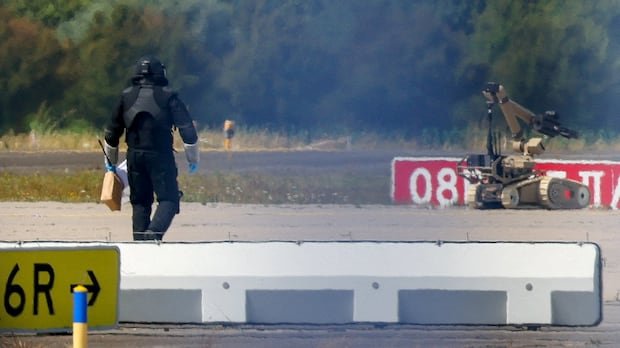

German authorities are probing a drone carrying explosives and a detonator discovered at Leipzig airport, while Russian Foreign Minister Sergey Lavrov has indicated Moscow’s plans to escalate retaliation against nations supporting Ukraine.
In an interview with VGTRK, Russia’s state media, Lavrov stated, “We will employ more severe methods to dismantle everything aiding the West in arming Kyiv’s military machine. We are already taking action.”
The drone, containing an unidentified explosive device, was found by an airport staff member in the cargo operations zone’s security area near Leipzig airport’s south runway, which is considered critical infrastructure. Leipzig serves as a key NATO airport used for transporting arms, ammunition, weapons, and other military supplies to Ukraine through flights operated by Ukrainian cargo companies.
The discovery of the drone adjacent to one of the Ukrainian cargo planes represents a heightened level of threat for Germany, as mentioned by the country’s interior minister. Alexander Dobrindt remarked that the incident appears to be part of a sophisticated hybrid threat scenario rather than the work of amateurs.
German authorities are conducting an investigation into the incident without disclosing the drone’s origin. Recent intelligence reports from U.S. officials to the Wall Street Journal suggest that the drone likely belonged to the Russian government.
As Germany cautiously responds by enhancing anti-drone capabilities and refraining from premature attributions, Dobrindt emphasized the ongoing process of establishing facts before making official statements.
The growing concerns about Russia’s utilization of drones, espionage, sabotage, and influence operations across Europe, including potential interference in upcoming regional elections in Germany, have prompted officials to acknowledge the evolving threat landscape.
Germany contends with daily hybrid warfare targeting espionage, sabotage, cyber attacks, and covert foreign actions to destabilize the country and bring about political and social changes. Recent incidents, such as the thwarted assassination plot against a German defense contractor CEO and the arrest of a suspected Russian spy scouting sabotage targets, underscore the gravity of the situation.
The Institute for Strategic Dialogue has been monitoring Russia’s online interference campaign, Operation Overload, which aims to exploit emerging controversies within NATO member countries and Ukraine, particularly targeting Germany, France, and Ukraine. The campaign seeks to undermine Ukrainian war efforts and destabilize democracies through disinformation tactics.
Amidst these escalating hybrid warfare tactics, senior officials express concerns about Russia’s aggressive probing of Germany’s tolerance levels, with the drone incident in Leipzig viewed as a bold escalation. The shift in Lavrov’s rhetoric signifies a departure from past denials of Russia’s involvement in Western countries, signaling a more aggressive stance against Europe, the West, and NATO.
The evolving landscape of hybrid warfare poses urgent questions about the boundaries between defense and direct conflict, prompting calls for clear delineations to deter further escalations.