

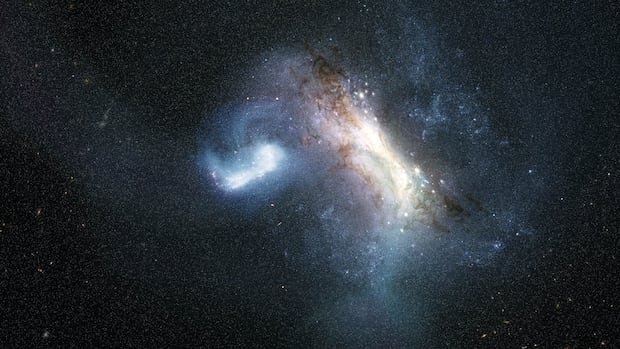

A recent study has revealed a significant event in the history of the Milky Way galaxy. Scientists have found evidence indicating that approximately 11.8 billion years ago, when the universe was still young, our galaxy merged with a smaller dwarf galaxy. This merger, the earliest known in the Milky Way’s history, played a crucial role in shaping the galaxy we see today.
By examining stellar clusters near the center of the Milky Way, researchers estimated that the dwarf galaxy contained stars equivalent to 500 million times the mass of the sun at the time of the merger. This smaller galaxy, named Low-energy-Kraken-Heracles (LKH), contributed to the growth of the Milky Way by adding stars and interstellar gas through the merger process.
The study, led by astrophysicist Davide Massari from the National Institute for Astrophysics in Bologna, Italy, used data from the Hubble and Gaia telescopes to analyze the age, composition, and trajectory of stellar clusters within the Milky Way. The research suggests that the merger infused the early Milky Way with the necessary resources for star formation and the mysterious dark matter.
Massari emphasized that the merger, though peaceful for stars, had a more explosive impact on the gas in both galaxies. The collision likely triggered the formation of numerous stars in the Milky Way. He also mentioned the presence of original dwarf galaxy stars still hidden within the Milky Way, particularly in stellar clusters in the inner regions.
Furthermore, the Milky Way has been involved in two other major galactic mergers in its history. It absorbed the Gaia-Sausage-Enceladus dwarf galaxy about 1.8 billion years after the LKH merger and has been merging with the Sagittarius dwarf galaxy over the past six billion years.
Understanding these merger events is crucial in unraveling the mysteries of the Milky Way’s past and its role in the formation of our solar system and Earth. The study sheds light on the origins of our galaxy and highlights the interconnectedness of celestial events shaping our cosmic neighborhood.