

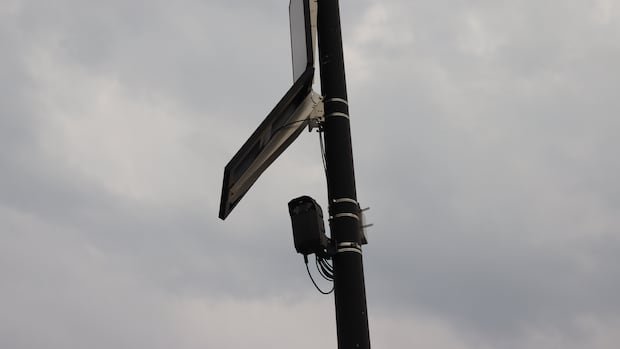

Montreal police have been expanding their use of AI-driven technology to monitor vehicles and individuals throughout the city discreetly, sparking concerns about transparency and privacy rights among the public.
Recently, a high-tech camera capable of scanning and recognizing vehicles was discovered by a Radio-Canada reporter on a lamppost along Henri-Bourassa Boulevard in Montreal’s Rivière-des-Prairies neighborhood. The camera, identified as a Cloudrunner CR-H2 made by Montreal-based Genetec, was promptly removed after Radio-Canada reported on its presence.
Unlike the controversial Flock Safety cameras widely deployed in the United States, Genetec’s system not only reads license plates but also records specific vehicle details like color, make, and model. The collected information is managed by its operator rather than shared in a central database accessible to multiple police forces.
According to SPVM spokesperson Marc-Antoine Bélanger, access to the captured images is restricted to the investigating team handling the specific case. The decision to remove the camera was explained as a measure to safeguard ongoing investigative strategies.
Despite claims from the SPVM about the secrecy surrounding their technological tools to avoid compromising investigations, privacy advocates argue that there has been a lack of transparency in introducing new technology to the public.
Dominique Peschard, a representative of the Ligue des droits et libertés, emphasized the importance of informing the public about the tools being utilized by the police while maintaining operational effectiveness.
The use of Cloudrunner cameras is part of the SPVM’s broader integration of AI technology, including the iMotion ROC AI software developed by Rank One Computing. The software aids investigators in reviewing extensive video footage without utilizing facial recognition or biometric features, as clarified by SPVM spokesperson Anik de Repentigny.
An internal privacy impact assessment by the SPVM highlighted the potential civil liberties risks associated with the technology, such as the inadvertent investigation of innocent bystanders and discrimination based on visible characteristics. Measures have been proposed to mitigate these risks, including configuring the software to search for objects rather than identifiable traits like ethnicity.
The revelation about the Cloudrunner camera followed a period of uncertainty within the SPVM, with Montreal police Chief Fady Dagher initially unaware of the device’s existence. The device, intended for targeting armed violence and vehicle thefts, was acknowledged by Chief Dagher later in the day.
While only one Cloudrunner camera was observed and removed, the SPVM indicated the possibility of adding more cameras based on the requirements of investigations dealing with criminal activities. Genetec assured that their technology prioritizes privacy and maintains detailed logs of data interactions.
The deployment of surveillance technology in Montreal aligns with the city’s evolving approach to public safety, as exemplified by Mayor Soraya Martinez Ferrada’s proposal to create a voluntary security camera registry. The regulations enforced by the Commission d’accès à l’information in Quebec emphasize the necessity for public surveillance to serve a legitimate and urgent purpose while collecting only essential information to address specific issues.
Legal experts, such as Jean-François Latreille, stress the importance of stringent controls on the usage of such tools to prevent individuals from losing control over their privacy, particularly in public spaces.