

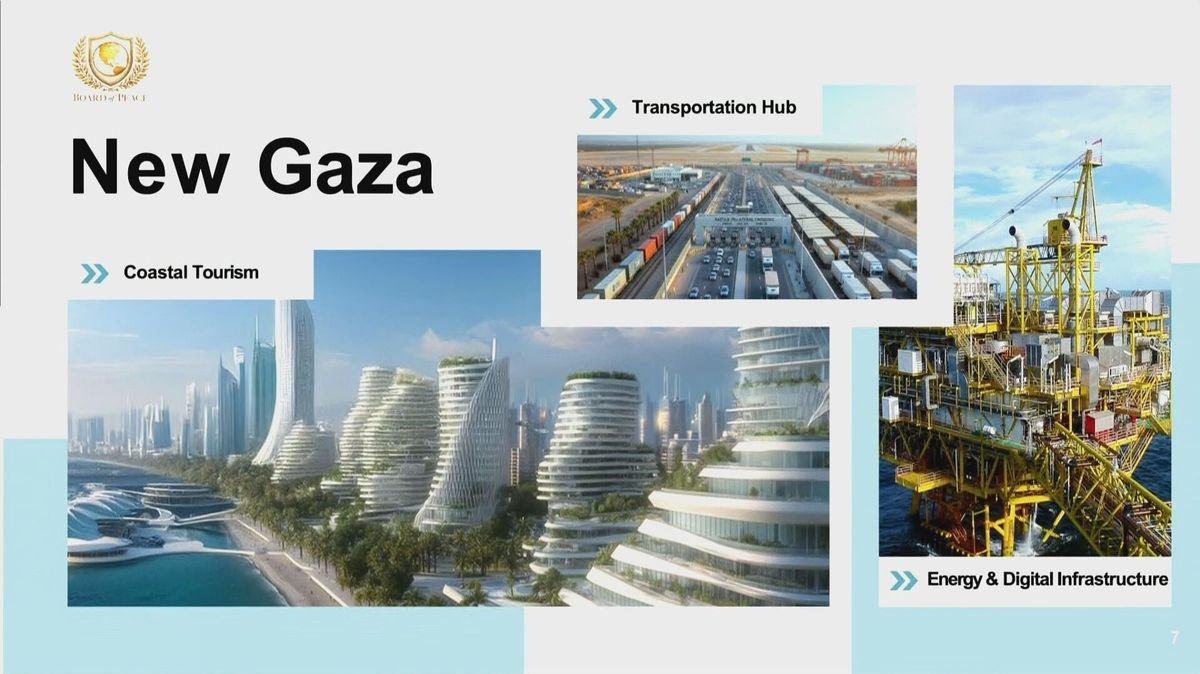

Donald Trump’s “Board of Peace” has unveiled a series of images showcasing the US President’s ambitious redevelopment plan for a post-conflict Gaza. Presented at the World Economic Forum in Davos, Switzerland, the photos depict a transformed Gaza coastline adorned with modern skyscrapers, promoting the concept of “New Gaza” and “New Rafah” as thriving business centers aimed at providing employment opportunities and essential services to the local population. However, critics view this initiative as a scheme orchestrated by opportunistic developers and authoritarian figures to exploit the region.
The proposed vision includes a revamped Gaza featuring advanced transportation networks and residential zones designed in circular patterns. Jared Kushner, Trump’s son-in-law and a key figure in the project, outlined a $25 billion proposal to elevate Gaza into a robust economic hub, projecting a potential GDP of $10 billion by 2035.
The redevelopment scheme envisions a specialized coastal tourism zone along the Gaza coastline, comprising 180 mixed-use towers, while the interior areas would accommodate residential communities and industrial facilities, such as data centers and manufacturing plants. Additionally, infrastructure plans encompass the establishment of a port, an airport, a trilateral crossing at Rafah, and a comprehensive network of ring roads to connect urban areas within Gaza.
Criticism has mounted against the proposal, particularly from displaced Palestinians who express skepticism about the motives behind the initiative. Concerns have been raised about the influence of figures like Benjamin Netanyahu and Trump in shaping the future of Gaza, with many questioning the tangible benefits this plan would bring to alleviate the ongoing suffering in the region.
Amidst the backlash, social media commentary has highlighted suspicions that the redevelopment scheme aims to exploit Gaza’s natural resources and strategic location, potentially undermining the Palestinian cause and the right of return.
The “Board of Peace,” which includes controversial world leaders such as Vladimir Putin and representatives from nations with authoritarian regimes, continues to face scrutiny over its intentions and alliances, further fueling the debate surrounding the proposed transformation of Gaza.